HPE Juniper Mist Campus Fabric
LAN/WLAN Campus NetworkingOverview

Juniper Mist Campus Fabric is Juniper's cloud-managed, AI-driven way to build a modern campus network "fabric" using EVPN/VXLAN, so you get a faster, more resilient wired LAN that is much easier to deploy and operate than traditional VLAN/Spanning Tree designs. In practice, you design and push the whole fabric from the Mist cloud, and the switches self-configure into a consistent, segmented campus network.
At a high level, a "campus fabric" is just a smarter way of wiring up buildings, floors, and closets so that all those switches behave like one coordinated system instead of a pile of individually configured boxes. Juniper uses a standards-based EVPN/VXLAN fabric under the hood: VXLAN is like a set of virtual tunnels riding over IP, and EVPN is the control plane that tells switches where users and devices are, which gives you flexible L2/L3 connectivity without depending on legacy Spanning Tree.
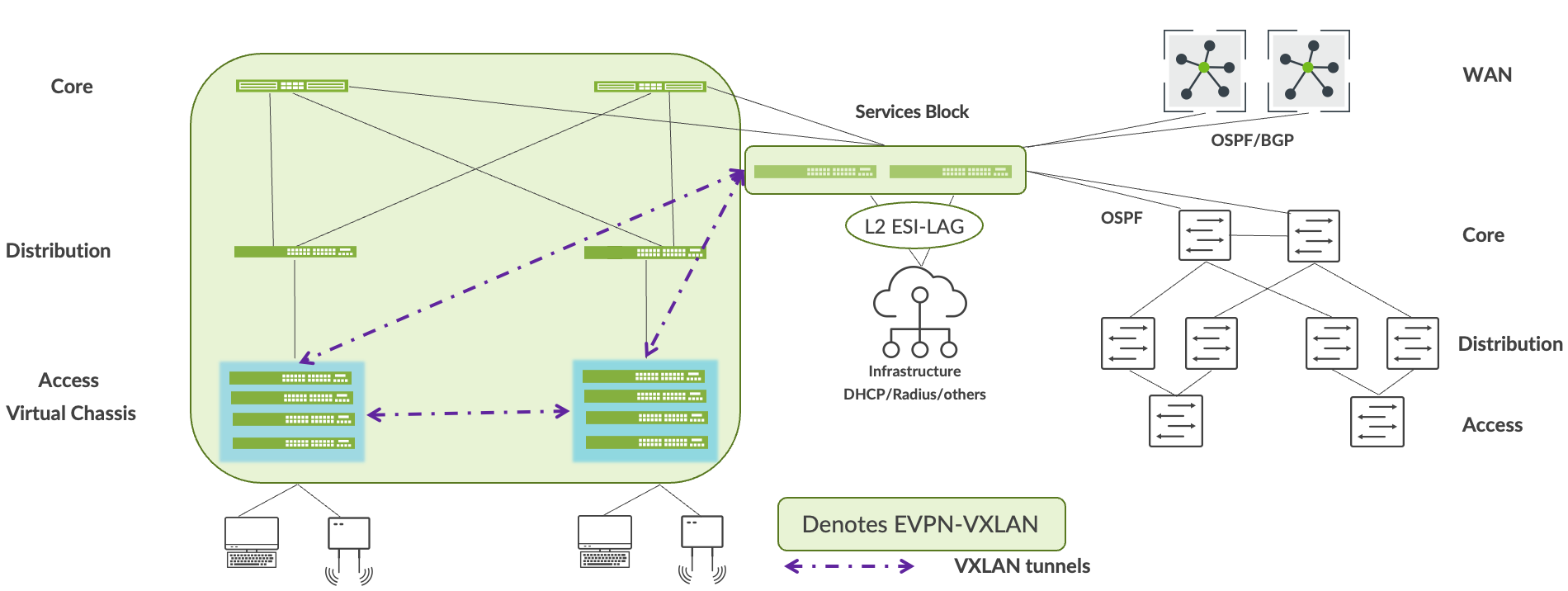
Mist Wired Assurance and Mist AI sit on top of that fabric: you tell the cloud what you want (sites, roles, segments, topology), and Mist generates and pushes correct fabric configs to the EX switches. The same cloud then continuously collects telemetry, measures "service level expectations" (SLEs), and uses the Marvis AI assistant to highlight or even auto-fix issues, so operations feel closer to "autopilot" than manual CLI firefighting.
Think of it like planning a city once in a central system (roads, neighborhoods, bus lines) and then having all the traffic lights automatically coordinated, instead of re-programming every intersection by hand.
How to position it
Target customers
- Mid-to large-enterprise campuses that struggle with complex VLAN/Spanning Tree designs and want a cleaner, more scalable architecture (universities, hospitals, public sector, large office campuses)
- Organizations modernizing for hybrid work and WiFi 6/6E deployments, where the wired network must handle lots of video, collaboration, and a mix of user, and IoT devices
- Customers that care about operational simplicity and small IT teams: they want cloud-like operations, AI-driven troubleshooting, and fewer tickets, not deep BGP/EVPN expertise in-house.
In non-technical terms: any campus where "keeping the network running" currently consumes too much human time, or where upcoming wireless/IoT growth will break the old design, is a prime candidate.
Easy entries
- Existing Mist WiFi customers still running legacy wired: they already know and like the Mist cloud, and Campus Fabric lets them extend the same AI-driven model to the switches
- Brownfield networks with frequent outages or weir VLAN/storm issues: EVPN/VXLAN fabric removes a lot of the fragility of big Layer 2 domains and Spanning Tree, giving predictable segmentation and active-active links
- Environments with lots of IoT/OT (cameras, sensors, medical gear) where segmentation is a security concern: fabric-level VRF's and group-based policies make it much simpler to keep "machines" separated from "people"
A useful sales angle: "You don't have to be a fabric guru. The Mist cloud builds the fabric; you just pick a layout and define who should talk to whom."
Cross-sell opportunities
- Mist Wireless Assurance and APs: sell a full AI-driven wired and wireless campus managed from the same portal and AI engine
- Marvis Virtual Network Assistant licenses: position Marvis as the AI "network engineer" that answers questions and triggers self-driving actions for both wired and wireless
- Juniper EX switches (especially EX4400 and newer): hardware that is purpose-built to be cloud-managed with Mist and act as VTEPs (VXLAN Tunnel Endpoints) in the EVPN/VXLAN fabric
- SD-WAN and security (SRX, SASE) behind the fabric: fabric VRFs steer traffic to firewalls or SD-WAN edges, enabling clean separation of guest, corporate, and OT zones
Core Features
- Standards-based EVPN/VXLAN campus fabric for L2/L3 connectivity across the campus, decoupling logical networks from physical topology
- Cloud-native management via Juniper Mist Wired Assurance, with intent-based workflows for fabric creation and switch deployment
- Multiple fabric topologies: EVPN multihoming (collapsed core), core-distribution campus fabric, and IP Clos for larger multi-building designs
- Built-in segmentation: VRFs for macro-segmentation plus group-based policy over VXLAN for finer-grained micro-segmentation
- AI-driven operations: Mist AI, SLEs (Service Level Expectations), detailed wired analytics, and Marvis actions and virtual assistant for proactive troubleshooting
- Zero-touch provisioning and activation-code onboarding for EX switches, plus templates, port profiles, and dynamic port profiles
- Open APIs for automation and integration into existing IT workflows and multi-vendor environments
- Active-active access uplinks with EVPN multihoming and ESI-LAG, eliminating the need for Spanning Tree between access and core
Pick your topology, define your segments, plug in the switches. Juniper Mist and AI do the rest.
Feature overview
EVPN/VXLAN fabric and topologies
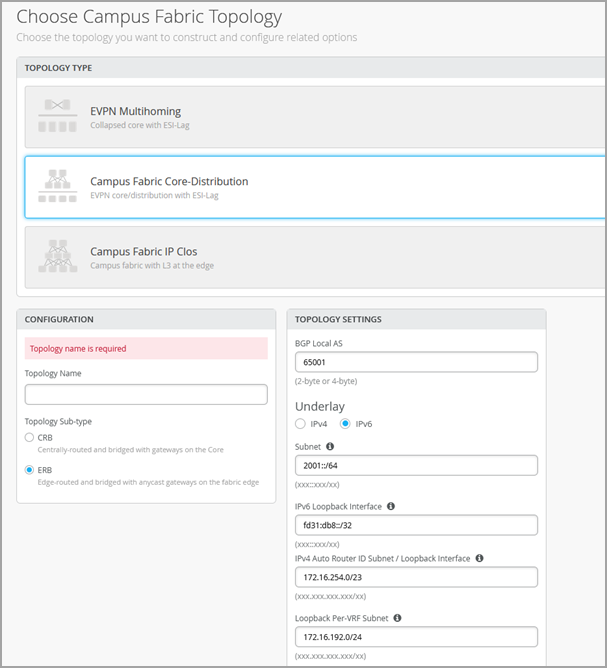
Juniper's campus fabrics all use a single EVPN/VXLAN framework, whether you have a small collapsed-core design or a large IP Clos with multiple buildings. VXLAN is like wrapping each "virtual neighborhood" (VLAN/segment) inside its own tunnel, so you can stretch or move it anywhere in the campus without rewiring the underlay IP network.
EVPN is the directory service that tells switches where devices live, so instead of flooding and learning like old-school Ethernet, switches exchange precise reachability info. This enables active-active uplinks from access to core (via EVPN multihoming and ESI-LAG), which means you use all your links all the time and avoid the "one link blocked by Spanning Tree" problem.
Cloud-native, intent-based management
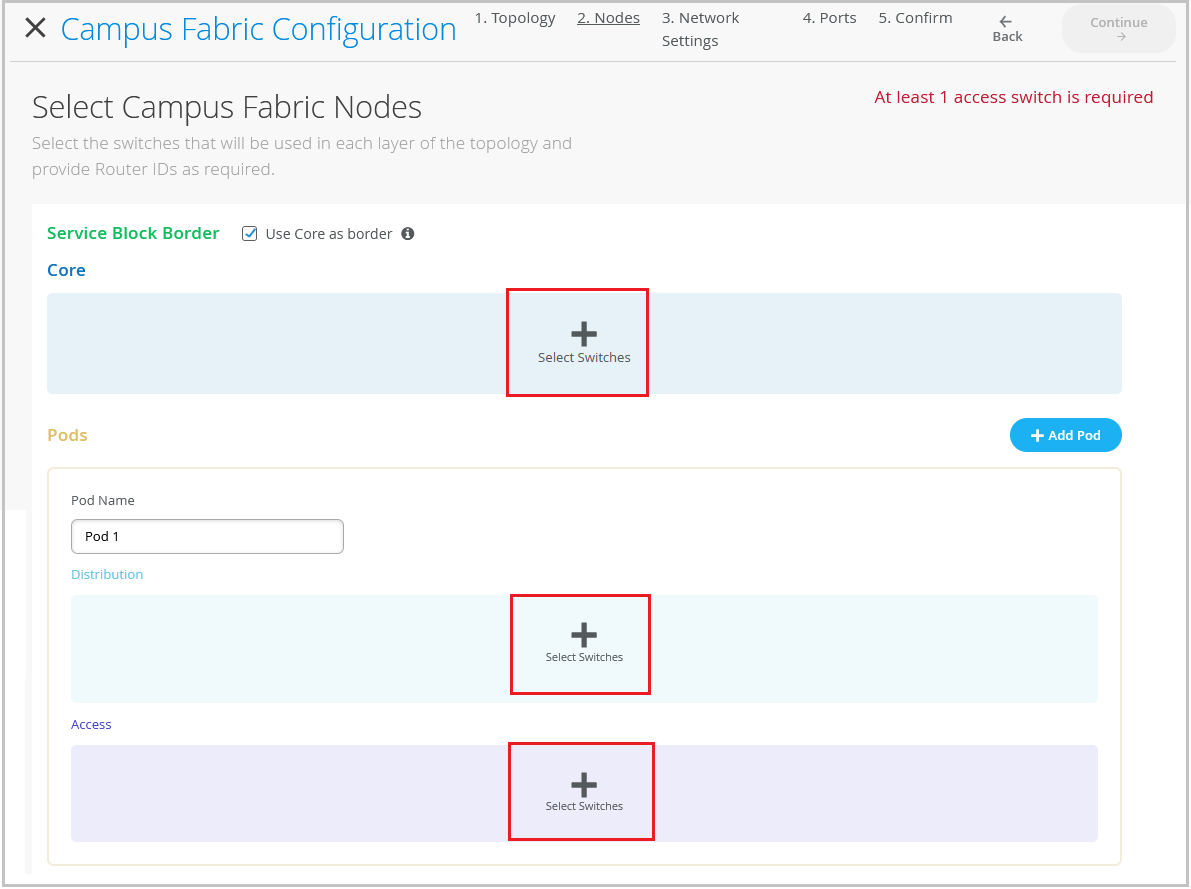
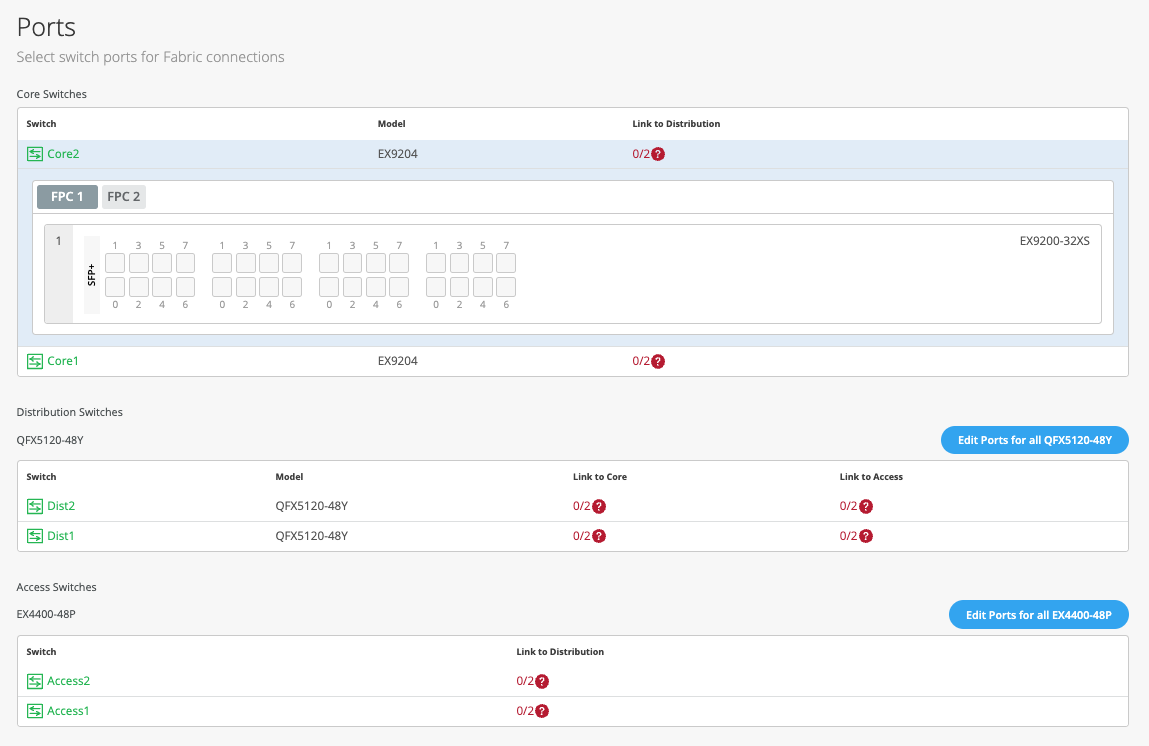
With Wired Assurance, you design the fabric from the Mist UI: pick devices, choose fabric topology (EVPN multihoming, core-distribution, or IP Clos), assign roles and links, and Mist generates the correct underlay and overlay configuration. You no longer have to hand-craft BGP, EVPN, or VXLAN stanzas on each switch; the cloud becomes the single source of truth for templates, VLANs, and port profiles
For a non-technical analogy: it's like designing a floor plan in software and letting the contractor automatically derive the wiring, plumbing, and materials list, instead of drawing every pipe and cable by hand
Segmentation with VRFs and group-based policy
Campus Fabric uses VRFs to create big, isolated "macro" segments such as Corporate, Guest, and OT, with traffic between VRFs typically forced through a firewall or external router. Within those VRFs, group-based policy over VXLAN lets you define more granular rules: for example "Cameras can only talk to video servers, not to PCs," enforced consistently across the whole fabric
This removes the need for sprawling, hand-maintained ACLs on individual switches and turns security into a fabric-level property: move a device anywhere, and its security posture follows automatically.
AI-driven operations, SLEs, and Marvis
Mist AI continuously analyzes telemetry from switches and connected devices and surfaces insights as SLEs: metrics like throughput, capacity, and uptime mapped to user experience rather than just "CPU 80%". When something degrades, Marvis can pinpoint likely root causes (bad cable, misconfigured port, upstream problem) and in some cases trigger "self-driving" remediation actions automatically.
Non-technical view: instead of waiting for users to complain that "the network is slow", the system notices patterns early, tells you what's wrong in plain language, and often fixes it before it becomes a visible outage.
Zero-touch provisioning and templates
New EX switches are ordered with Mist support; you receive an activation code, add it to the Mist dashboard, and the switches appear in the cloud even before they ship. When you rack and power them, they use zero-touch provisioning (ZTP) to call home, get their role (access/core), port profiles, and fabric membership, and then join the campus fabric automatically.
Global templates and port profiles mean "one definition, many uses": define how an access port for "Office User" or "Camera" should behave once, and apply it everywhere, which dramatically reduces config drift and human errors.
Open APIs and ecosystem
Everything you can do in the Mist UI is backed by open APIs, so larger customers or MSPs can script onboarding, integrate with ITSM tools, or build their own portals on top. Because the fabric is standards-based EVPN/VXLAN, it also plays relatively well in multi-vendor environments and with third-party security or analytics tools.
In business terms, that means you're not boxed into a black-box controller; you get automation and AI benefits without sacrificing interoperability or the ability to plug it into your broader IT workflows