Extreme Fabric Connect
LAN/WLAN Campus NetworkingOverview

Extreme Fabric Connect is Extreme Networks' SPB-based network fabric that virtualizes and automates wired networks across campus, data center, and branch so you can run many secure "virtual networks" on one physical infrastructure while simplifying operations and improving resilience. Think of it as turning your network from a tangle of independent switches and protocols into a single, self-aware transport system where you only define services at the edges and the fabric handles everything in between
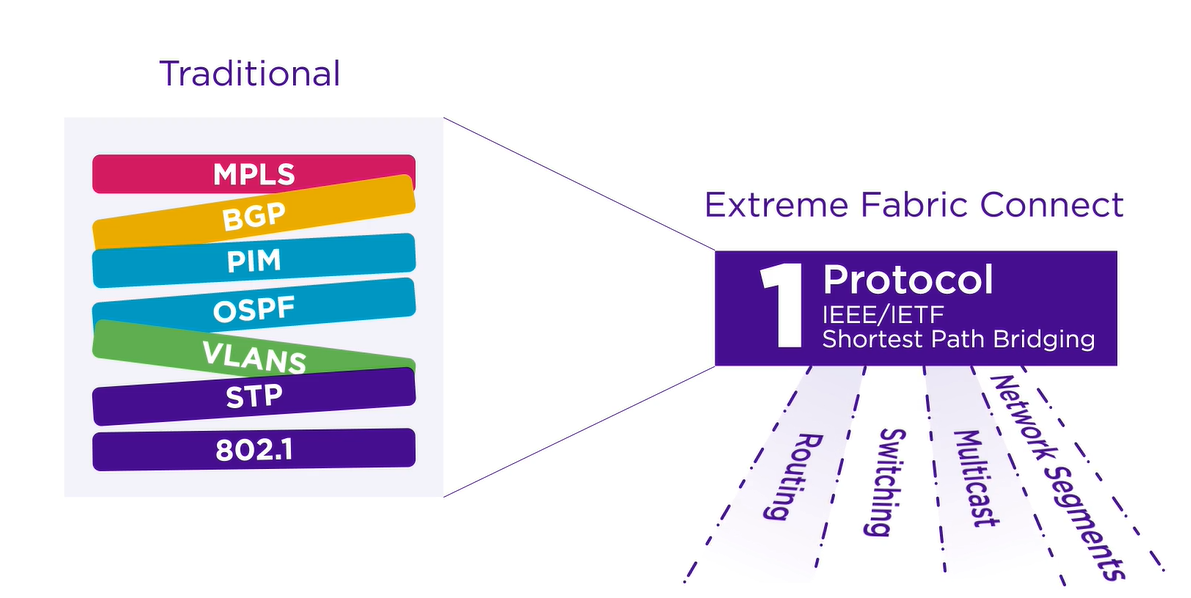
Fabric Connect is an enhanced implementation of IEEE 802.1aq Shortest Path Bridging (SPB) and related standards that provides end-to-end Layer 2 and Layer 3 virtualization, including IP routing and multicast, using a single technology. Instead of running separate protocols like Spanning Tree, OSPF/RIP, ECMP, and PIM, those functions are effectively folded into the fabric so the control plane computes optimal shortest paths and service topologies automatically.
Conceptually, it turns the physical network into a "cloud of transport" and then carves out multiple isolated virtual networks (segments) on top, each with its own routing and security context. A simple anology: one road system (the physical switches and links) but many completely separate, invisible lanes laid over it for different departments, applications, or tenants, all without having to rebuild the road each time you add a lane.
Positioning
Extreme positions Fabric Connect as the core of its "Unified, Automated, Secure" fabric story across campus, data center, and branch, intended for organizations that need agility but are constrained by complex legacy designs. It resonates particularly where small IT teams must manage large or distributed environments and want to reduce manual configuration, cut downtime, and strengthen segmentation without becoming SPB experts.
Target customers
Real-world deployments span hospitals, universities, local and regional government, ports, stadiums, casinos, and exhibition centers: places with mission-critical connectivity and a lot of change at the edge. Examples include a Dutch hospital with 11 years of zero downtime, large colleges achieving >99% uptime, and government networks connecting dozens of remote communities with very small central IT teams.
In practice, good targets are mid-to-large enterprises with: multi-site campuses, converged OT/IT (CCTV, BMS, access control), heavy multicast (video, IPTV), or compliance-driven segmentation needs that are painful to deliver with classic VLAN/VRF/BGP designs. Any customer already considering Extreme wired/wireless or ExtremeCloud IQ is a natural fit because Fabric Connect is now the default strategic architecture in that ecosystem.
Easy entry-points
"Brownfield cleanup" is very strong: environments where Spanning Tree, lots of manually extended VLANs, and complex routing/ACL meshes are causing outages or long change windows can often be simplified dramatically by replacing the core/aggregation with Fabric Connect while keeping existing access switches via Fabric Attach. IoT and CCTV segmentation is another easy win: Fabric can hypersegment these workloads into dedicated virtual networks that never touch the rest of the infrastructure, improving security without re-architecting the whole network.
Remote sites and branches connected over an IP/MPLS or Internet WAN are also attractive: Fabric Extends, Fabric over SD-WAN and IPsec gateways let you stretch fabric services over existing WANs and automate service provisioning to branches, often cutting deployment time by more than 90% compared to traditional manual builds
Cross-Sell Opportunities
Fabric Connect is tightly linked with Extreme's broader portfolio: it underpins Extreme Fabric (the overall solution), integrates with ExtremeCloud IQ, Extreme Platform ONE and ExtremeCloud IQ - Site Engine for centralized management and automation, and extends over ExtremeCloud SD-WAN. That makes it a natural anchor for cross-selling
- Extreme wired access and "universal switches" at the edge, which become Fabric Attach clients or fabric nodes
- Extreme wireless, where APs can automatically map SSIDs into fabric services using Fabric Attach, simplifying SSID-to-segment design
- ExtremeCloud IQ, Extreme Platform ONE and ExtremeCloud IQ - Sit Engine for end-to-end visibility, zero-touch onboarding of new fabric nodes, and policy-based automation
Core Features
Technically, Fabric Connect is a Shortest Path Bridgning-based fabric that delivers integrated Layer 2 and Layer 3 virtualization, unicast and multicast, with edge-only service provisioning. Service are modeled as "Virtual Services" (L2 and L3 instances, often VRFs) that ride over a common SPB control plane, eliminating the need for multiple overlay technologies.
Core characteristics include: unified fabric across campus/data center/branch, automated formation of the fabric topology, built-in fast convergence and self-healing, hypersegmentation for security, and support for advanced capabilities like Distributed Virtual Routing (DVR) and native multicast without PIM.
| Feature | What it means in plain terms | Technical perspective |
|---|---|---|
| Unified, virtualized fabric | One logical fabric across campus, data center, and branch where you can spin up many isolated “virtual networks” for different users, apps, or tenants without rebuilding the physical network each time. | Based on IEEE 802.1aq SPB with integrated L2/L3/IP multicast; services are Virtual Service Instances (VSIs) and VRFs carried over a single SPB control plane, replacing STP, multiple IGPs, and PIM. |
| Edge‑only provisioning & automation | You configure services where devices connect; the fabric automatically makes them reachable everywhere they need to be, reducing human error and change windows. | SPB computes shortest paths and distributes service membership; features like Zero‑Touch Fabric Infrastructure and auto‑sensing ports allow fabric nodes and Fabric Attach devices to join and be provisioned automatically. |
| Hypersegmentation & “stealth core” | The core carries traffic but is effectively invisible to users and attackers; critical services can be placed in completely isolated segments that are not even routable to each other by default. | Separate SPB service IDs and VRFs are used to create strongly isolated segments, with no shared control protocols in the core and optional policy integration for macro‑ and micro‑segmentation. |
| Distributed Virtual Routing (DVR) | Routing happens closer to users and servers, reducing hair‑pinning and latency; it feels like every major switch can be a local gateway for its connected VLANs. | DVR distributes VRF instances and IP shortcut routing across multiple fabric nodes, using SPB’s control plane to advertise IP reachability so traffic takes optimal shortest paths between segments. |
| Native multicast without PIM | Multicast video/voice/apps become simpler to deploy and scale; you no longer need a separate PIM design or complex rendezvous‑point planning. | Multicast trees are computed natively in the SPB control plane using IS‑IS extensions, so IP multicast services are carried as SPB services, eliminating separate PIM signaling and state. |
| Fabric Attach (automation to non‑fabric edges) | You can keep existing access switches or third‑party devices, which automatically “plug into” the right virtual network on the fabric, lowering migration cost and risk. | LLDP‑based signaling between Fabric Attach clients (e.g., access switches, APs) and Fabric Attach servers (fabric edge nodes) advertises service requirements; the server then maps the port into the requested fabric service without manual VLAN/VRF stitching. |
| Fabric Extend & SD‑WAN integration | Branches and remote sites can behave as if they are part of the same fabric even over an IP/WAN or Internet underlay, which simplifies multi‑site designs and policy. | Fabric Extend encapsulates SPB services over IP or MPLS and can be combined with IPsec gateways for secure extension; integration with ExtremeCloud SD‑WAN automates tunnels and service mapping from a single orchestration plane. |
| Zero‑Touch Fabric Infrastructure | Large fabric rollouts (dozens to hundreds of switches) can be deployed with minimal manual configuration; devices auto‑form the fabric and onboard to management. | New fabric nodes use auto‑discovery, auto‑sensing ports, and secure onboarding to ExtremeCloud IQ or Site Engine, where they receive IP settings and base configuration without per‑device CLI builds. |
| Integrated security & policy | Network segmentation, access control, and threat isolation are built into the fabric, so security posture changes can be expressed as fabric policies instead of ad‑hoc ACLs everywhere | Fabric works with Extreme’s policy framework and NAC/ZTNA capabilities to enforce consistent macro‑ and micro‑segmentation; segments can be elastically added/removed in parts of the network without touching the rest. |