Cato Networks ZTNA
NAC/ZTNAZTNA

Overview
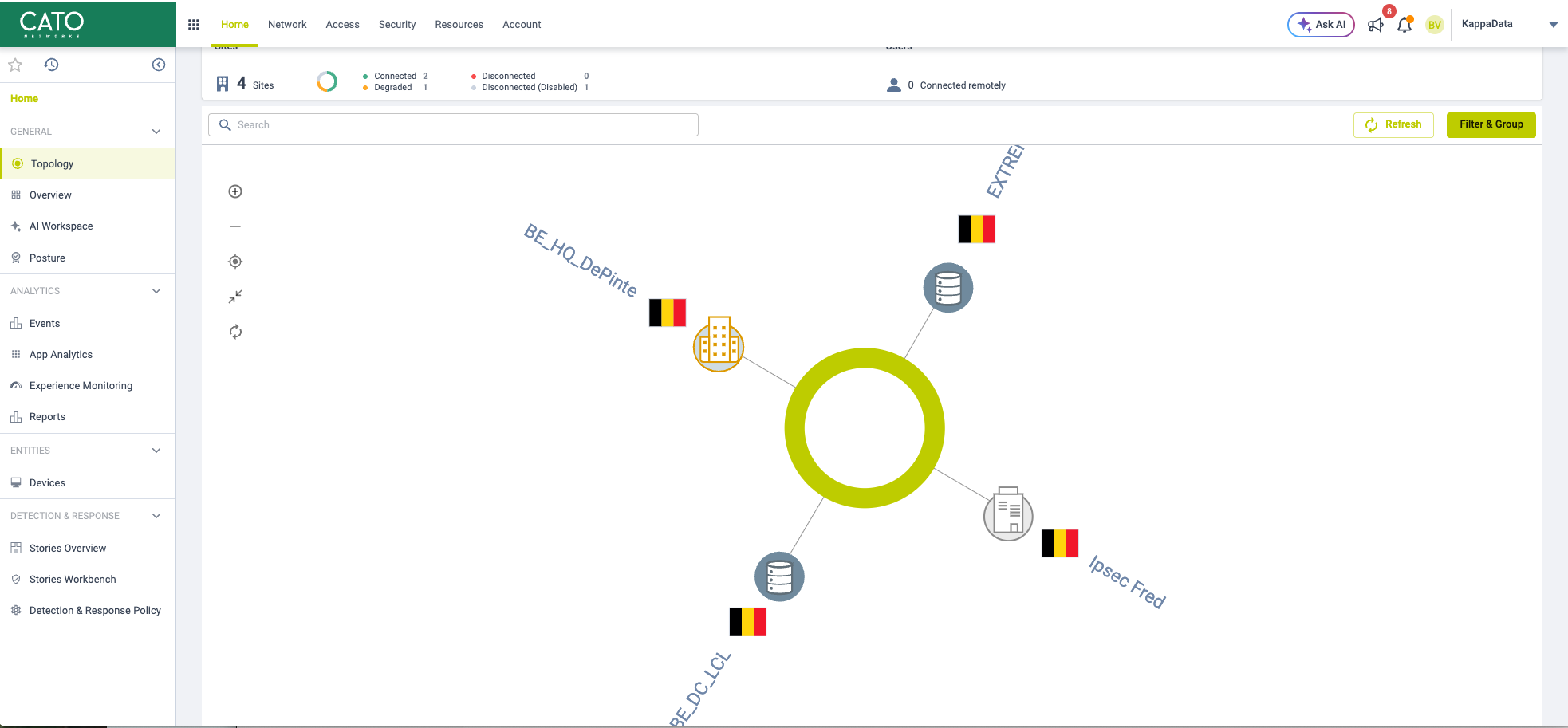
Cato Networks delivers ZTNA as a native capability of its single-vendor SASE cloud, giving you per-user, per-app zero-trust access with integrated networking and security rather than a bolt-on remote-access product. From a ZTNA perspective, you should think of Cato less as "a VPN replacement" and more as "a global access fabric with zero-trust and traffic inspection baked in."
Cato ZTNA implements classic zero-trust principles: explicit identity verification, least-privilege access and continuous inspection, but enforces them from a global cloud platform that also provides SD-WAN, NGFW, CASB, DLP and a private backbone. Users connect via a Cato client, browser extension or site appliance (Socket) into the Cato SASE Cloud, where a single policy set decides which specific applications and resources they can reach, regardless of whether they are in an office, at home or fully remote.
Instead of exposing networks, Cato publishes applications behind software-defined perimeters; access is deny-bey-default and limited to explicitly allowd apps, which prevents lateral movement and enables microsegmentation at the network layer. All user sessions are inspected in real-time across all ports and protocols, with services such as CASB and DLP applied to both WAN and Internet traffic, so ZTNA is part of a broader, consistent security fabric rather than a separate tunnel.
Cato's ZTNA rides on a global private backbone with dozens of PoPs interconnected by tier-1 carriers, so remote users generally see office-like performance instead of hairpinned VPN latency. This "access + transport" combination is a key differentiator versus ZTNA point products that rely on the public Internet for the middle mile.
How to position
Target Customers
Cato is strongest with mid-market and enterprise customers that have a distributed footprint: multiple branches, global users, SaaS and IaaS. Companies that want to consolidate networking and security into one cloud platform are the ideal fit. Forrester highlights Cato as a good fit for multinationals, financials and firms looking to replace MPLS and consolidate security functions, which aligns well with customers modernizing WAN and remote access together.
Industries with many sites and strong compliance needs (such as retail, manufacturing/OT, professional services, healthcare), map well to Cato's model of centrally managed, cloud-delivered security with per-user zero-trust access. Organizations already embracing "work from anywhere" and heavy SaaS usage will value the fact that Cato applies the same ZTNA and inspection model to private apps, Internet and SaaS destinations.
Easy positioning tips
An easy entry point is any customer suffering from legacy VPN pain: appliance sprawl, split management, slow remote access and difficulty extending access to contractors and BYOD. Cato's client and browser-extension-based ZTNA replaces traditional VPN concentrators with identity-aware, per-app access, including unmanaged and BYOD devices via a browser extension that enforces zero-trust policies without installing a full client.
Another low-friction use case is organizations planning MPLS offload or SD-WAN refresh; here you position Cato as "SD-WAN + ZTNA + security stack in one move," instead of stitching together a WAN vendor plus a separate ZTNA and firewall stack. M&A scenarios, rapid branch rollout and cloud migration are also good triggers, because Cato's cloud model makes it easy to onboard new sites and apps while enforcing the same ZTNA policies everywhere.
Cross-sell opportunities
If a customer already uses Cato for SD-WAN or secure Internet breakout, ZTNA is a natural upsell: you extend the same platform to cover remote users and private app access with the same policies and logs. Position this as "one console, one policy engine, one client" for branch, data center, cloud and remote users rather than adding another remote-access product.
Conversely, if you land with ZTNA first as a VPN replacement, the cross-sell motion is to migrate site-to-site VPNs and Internet security into the same Cato backbone, then layer on CASB, DLP and FWaaS to fully consolidate the perimeter. This lets you tell a story of progressive simplification: start with user access, then collapse edge firewalls, MPLS and SWG into Cato's SASE cloud.
Core Features
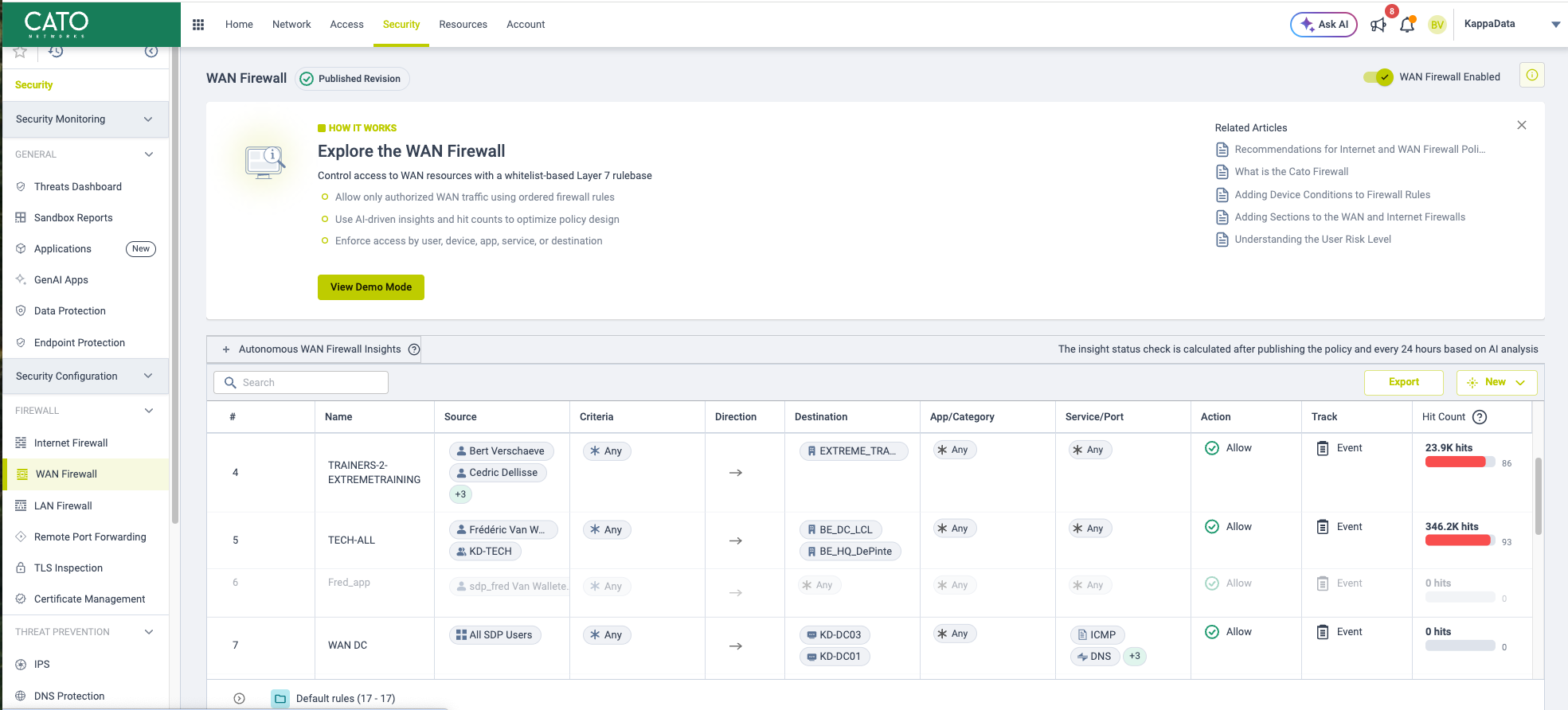
From a technical angle, the main Cato ZTNA capabilities are:
- Universal, risk-based access policy: A single ZTNA policy is defined using identity plus contextual attributes such as device posture, user geography, application risk and compliance ratings, and then enforced consistently for all users and locations
- Client and clientless access: Cato provides an endpoint client (Cato Client) for managed devices and a browser extension for unmanaged/BYOD, alongside site appliances (Sockets)
- Continuous device posture evalutation: Device posture (OS, patch level, AV, disk encryption, firewall, certificates, geo-location) is checked at connection time and continuously during the session; non-compliant devices can be fully disconnected or limited to specific resources
- Deep, continuous threat inspection: All sessions undergo deep content inspection across all ports and protocols, with integrated CASB and DLP providing in-line and out-of-band protection against data exfiltration and SaaS misuse
- Defautl-deny and microsegmentation: Access is inherently deny-by-default, and granular WAN firewall rules define exactly which apps and services a user or group may reach, effectively microsegmenting the network
- Global private backbone and optimization: Cato's ZTNA rides on a global, SLA-backed private backbone with WAN optimization and QoS to deliver consistent performance to cloud and on-prem applications from anywhere
- Centralized, cloud-native management: Policies, logs, digital experience metrics and security controls are managed centrally in the cloud via a unified console, with ZTNA tightly integrated into the broader SASE platform
Feature Overview
| Area | What it does (technical) | Why it matters (sales/benefit) |
|---|---|---|
| Access model | Uses identity and context (user, group, device posture, geo, app risk) to grant least‑privilege access to specific apps, not networks | Minimizes lateral movement and breach impact; easier to explain to auditors than broad network VPN access. |
| Policy scope | Single ZTNA policy engine applies to users in offices, at home, remote, and for both private and cloud apps | One place to manage access for all users and locations; reduces admin overhead and misconfigurations. |
| Client / clientless | Cato Client for managed endpoints, Cato Browser Extension for unmanaged/BYOD, Sockets for sites, all tied to the same policy | Covers employees, contractors and partners without complex onboarding; no need for separate “enterprise browser” products. |
| Device posture | Continuously evaluates OS, patches, AV, disk encryption, firewall and certificates during the session; can block or limit access if non‑compliant | Turns security baselines into enforceable controls; strong story for compliance, ransomware prevention and endpoint hygiene. |
| Security services | In‑line NGFW, CASB, DLP and threat prevention inspect all traffic, not just ZTNA tunnels, across all ports and protocols | Eliminates point products (VPN, SWG, CASB, DLP appliances) and ensures consistent policy and logging everywhere. |
| Network underlay | Traffic traverses Cato’s global private backbone with optimization and QoS instead of random Internet paths | Better app performance and user experience vs. traditional VPN; key differentiator for latency‑sensitive apps (VoIP, VDI, ERP). |
| Microsegmentation | WAN firewall and software‑defined perimeters restrict users to explicitly allowed apps/resources; default‑deny everywhere | Strong zero‑trust messaging: “users never get a flat network; they only see the apps they’re supposed to.” |
| Visibility & DEM | Central dashboard with logs, access attempts, and digital experience metrics (latency, path quality, per‑user diagnostics) | Faster troubleshooting and proof of value; operations teams see both security and performance in one place. |
| OT / branch coverage | Extends ZTNA controls and continuous inspection to OT networks and branch devices via Sockets and per‑session policies. | Lets you talk to manufacturing/retail customers about securing plants and stores with the same zero‑trust approach as HQ. |
| Management model | Fully cloud‑managed; updates and new features are delivered automatically across the platform. | Reduces upgrade projects and hardware refresh cycles; good TCO and agility story. |