Sophos EDR
Sophos EDR - Overview
Sophos Endpoint Detection and Response (EDR) is an enterprise-grade cybersecurity solution designed to protect organizations from advanced endpoint threats through intelligent detection, investigation, and automated response capabilities. The solution operates as a core component of Sophos' Intercept X Advanced Platform, combining real-time threat detection powered by artificial intelligence with forensic investigation tools and automated incident response.
At its foundation, Sophos EDR functions as a continuous security monitor for every computer and server in an organization. It watches for suspicious activity (from unusual processes running in memory to unexpected file modifications) and rorrelates this data with global threat intelligence from SophosLabs to identify both known and never-before-seen threats. Unlike traditional antivirus solutions that rely on signature databases (esentially lists of known bad files), Sophos EDR employs deep learning algorithms that can detect malware in approximately 20 milliseconds without requiring pre-existing knowledge of the threat.
The solution is delivered through a unified cloud-based management console called Sophos Central, which gives security teams and IT administrators complete visibility into endpoint security posture across the entire organization from a single location. What distinguished Sophos EDR from basic endpoint protection is its emphasis on the "detection and response" components, meaning organizations can not only prevent attacks but also investigate how breaches occured and automate containment actions to stop threats from spreading.
Key Positioning: Sophos EDR is rated #1 overall for EDR solutions by G2 in Spring 2025, with recognition across enterprise, mid-market and small business segments. Over 300.000 organizations globally trust Sophos Endpoint for protection
Positioning
Target Customer Segments
Enterprise Organizations
Sophos EDR is built for organizations with complex IT environments, distributed endpoints, and sophisticated threat landscapes. Enterprise customers benefit from centralized policy management, role-based access controls, and integration with other security tools in their existing infrastructure
Mid-Market Organizations
This segment represents a significant growth opportunity for Sophos. Mid-market organizations need enterprise-grade protection but with simplifiezd deployment and lower operational overhead. Sophos EDR provides this balance through intuitive dashboards and streamlined management
Small and Medium-Sized Businesses
In September 2025, Sophos launched Endpoint 100, a game-changing offering specifically designed for smaller organizations with up to 100 user endpoints and 10 servers. This represents a critical positioning move in the SMB market
Why Endpoint 100 matters for SMB
- One fixed annual price: covering both endpoints and servers (no per-seat surprises)
- Zero feature limitations: full Sophos Intercept X capabilities, not a stripped-down version
- Predictable budgeting: organizations know their exact security spend for 12 months
- Minimal management overhead: lightweight agent design means even IT teams without dedicated security staff can deploy and maintain it
- Enterprise-level ransomware protection including CryptoGuard anti-ransomware technology that prevents both local and remote attacks
Cross-Sell and Upsell Opportunities
Sophos EDR is the foundation for a comprehensive security stack, creating multiple pathways to expand customer relationships:
- Sophos Managed Detection & Response (MDR) Organizations that purchase EDR can upgrade to Sophos MDR, a fully managed 24/7 service where Sophos security analysts actively hunt for threats, investigate incidents, and execute response actions on the customer's behalf. This is particularly attractive for:
- Organizations lacking internal SOC/security expertise
- Mid-market and enterprise customers wanting to reduce operational burden
- Highly regulated industries requiring round-the-clock monitoring
For partners, MDR represents a high-margin recurring revenue opportunity and customer stickiness through service delivery
-
Sophos XDR (Extended Detection & Response) While EDR focuses on endpoint activity, XDR extends threat visibility to firewalls, email, cloud workloads, and identity systems. Customers can progressively upgrade EDR to XDR to gain cross-layer threat correlation and investigation. The Taegis XDR integration (following Sophos' 2025 acquisition of Secureworks) now bundles Sophos Endpoint automatically with XDR, reducing customer costs and simplifying the upgrade path.
-
Sophos Central Platform Expansions Customers managing EDR through Sophos Central can add:
- Firewall management (Sophos Firewall #1 ranked in G2 for firewalls)
- Email security (advanced threat protection, encryption)
- Mobile security (device management, mobile threat defense)
- Cloud security (SaaS application monitoring)
- Identity security (ITDR: Identity Threat Detection & Response)
Each product shares threat intelligence through the Sophos Security Ecosystem, enabling coordinated defense
Core Features
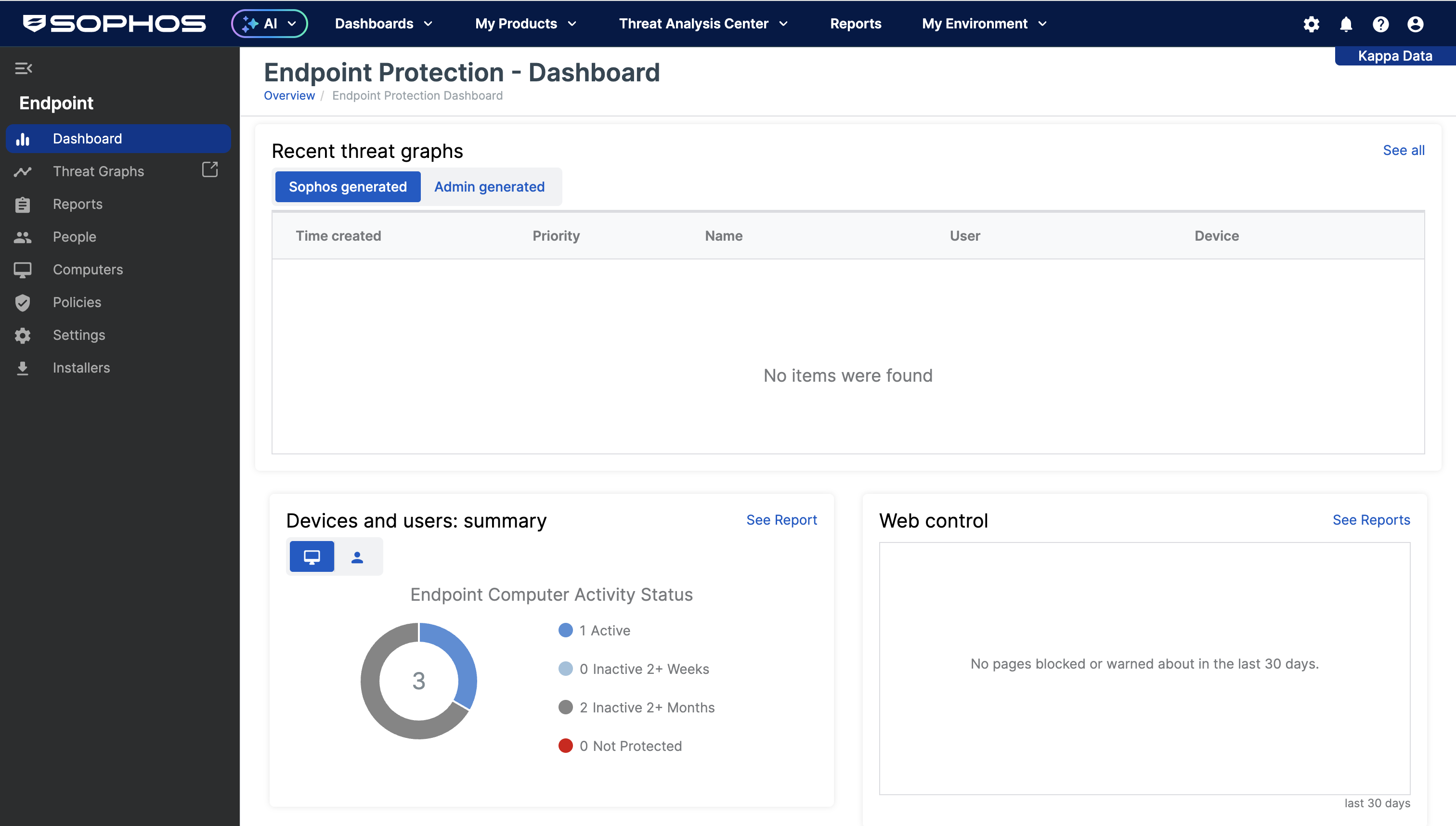
Sophos EDR integrates three critical security functions
- Threat Prevention: Stopping attacks before they succeed through advanced detection and exploitation prevention
- Threat Detection: Identifying suspicious and malicious activity in real-time across all endpoints
- Incident Response: Enabling rapid investigation and automated remediation when threats are discovered
Deep Learning Malware Detection
Sophos employs deep learning: an advanced form of artificial intelligence that analyzes hundreds of millions of file samples to detect both known and zero-day malware without relying on static signatures. The deep learning model processes complex file attributes and code patterns, comparing them to known good and known bad files to render a verdict in under 20 milliseconds. This approach makes Sophos capable of detecting malware even when the organization is offline and before the threat executes any malicious actions
CryptoGuard: Revolutionary Anti-Ransomware
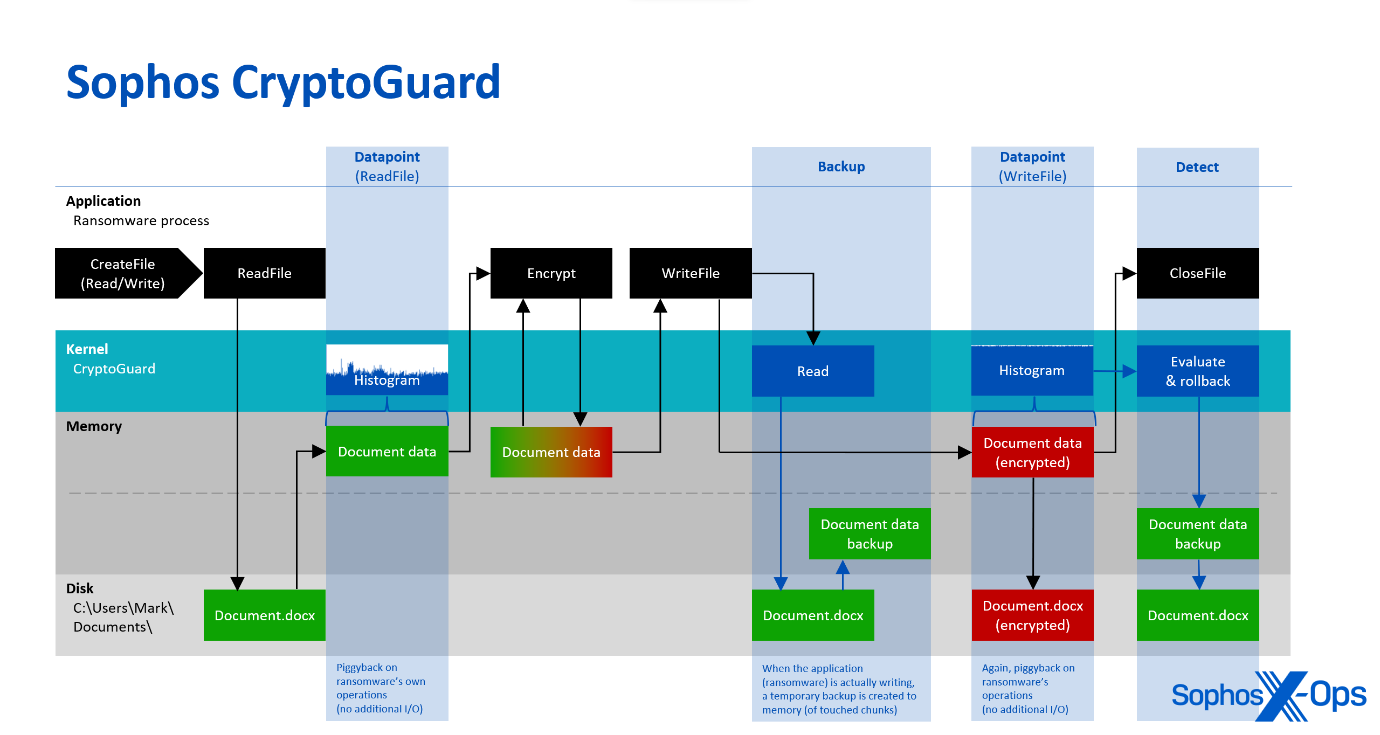
CryptoGuard represents one of Sophos' most differentiated capabilities. Unlike detection systems that look for "bad behavior", CryptoGuard takes an asymmetric approach: it continuously analyzes the contents of files being read and written, using mathematical algorithms to determine whether data is being encrypted without authorization.
The advantage is profound: CryptoGuard protects against ransomware even when:
- The ransomware binary itself isn't executed on the protected machine
- The attack originates from an unprotected remote machine targeting shared network folders
- New, previously unseen ransomware variants are used
When unauthorized encryption is detected, CryptoGuard automatically stops the offending process and rolls back any encrypted files to their pre-attack state, minimizing business disruption.
Exploit Prevention
Rather than waiting for malware to execute, exploit prevention blocks the techniques attackers use to abuse software vulnerabilities, preventing the initial compromise before malicious code even runs. This is critical because zero-day vulnerabilities (previously unknown flaws) can be weaponized within hours of discovery.
Behavior Analysis & Malicious Traffic Detection
The solution correlates suspicious endpoint behaviors (unexpected system changes, command-and-control C2 traffic, unauthorized administrative actions) with real-time threat intelligence to identify targeted attacks and data breaches. Behavior-based detection is essential for catching novel attacks that haven't been cataloged yet.
Real-Time Threat Monitoring
Sophos EDR continuously collects data from endpoints including system logs, file changes, network connections, process execution, user activities, and memory inspection. This telemetry feeds into AI-powered correlation engines that identify deviations from normal behavior and raise security events. The system doesn't overwhelm analysts with noise: machine learning prioritizes events by risk level, highlighting the most critical detections first.
SophosLabs Threat Intelligence Integration
SophosLabs Intelix provides curated, real-time threat intelligence for files, URLs, IP addresses, and domains. When an endpoint encounters a suspicious file, Intelix provides immediate classification: is it known malware, a potentially unwanted program, or clean? This leverages global intelligence from millions of Sophos-protected devices rather than relying solely on local analysis. Intelix includes both static analysis (file inspection without execution) and dynamic analysis via Sophos Cloud Sandbox, where suspicious files are safely detonated in an isolated environment to observe their actual behavior.
Multi-Platform Support
Modern organizations run Windows, Linux, macOS and increasingly containerized workloads. Sophos EDR provides consistent threat detection across all major platforms through a unified agent architecture
Automated Response Actions
When threats are detected, Sophos EDR can automatically execute containment actions including:
- Process termination: immediately stops malicious processes
- Ransomware rollback: recovers encrypted files to pre-attack state
- Network isolation: disconnects the infected endpoint to prevent lateral movement
- Adaptive Attack Protection: prevents exploitation of software vulnerabilities in real-time
These automated presonses significantly reduce the time between detection and containment, minimizing damage and dwell time (the period attackers have before detection)
Live Response: Direct Remote Access
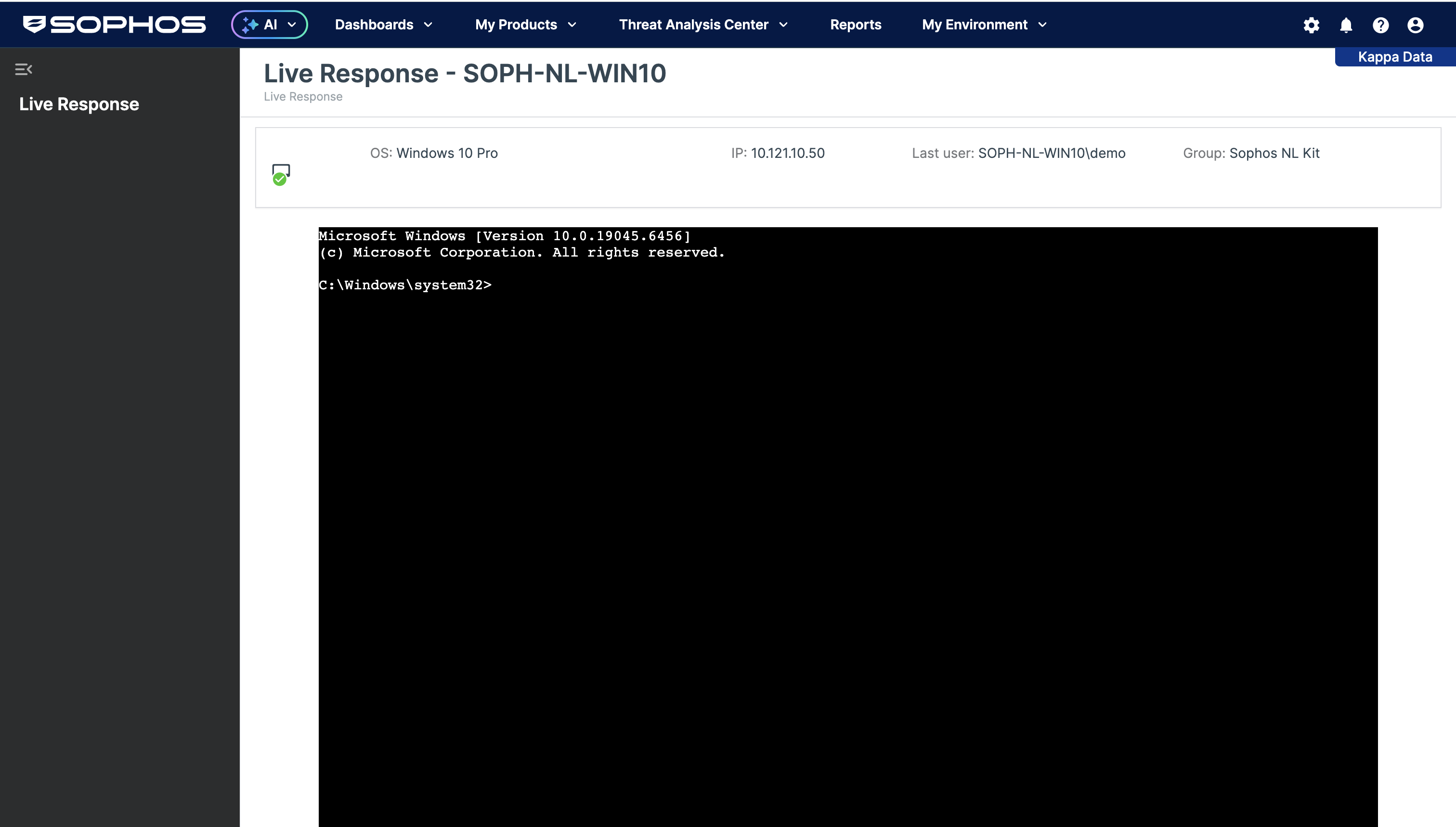
Security analysts can establish encrypted, audited remote shell sessions to suspicious endpoints, enabling them to:
- Stop suspicious processes
- Browse file systems and delete malicious files
- Run custom commands for investigation or remediation
- Install/uninstall software
- Execute third-party forensic tools
- Modify configuration files
- Restart systems
All Live Response activity is logged with timestamps, the administrator involved, the device accessed, and the session commands: creating a complete audit trail for forensic investigation and compliance.
Feature overview
Detection & Investigation Capabilities
Alert Prioritization with AI
Sophos Central presents security events in a dashboard that uses machine learning to automatically prioritize detections based on risk and business impact. Rather than flooding analysts with thousands of low-priority alerts, the system elevates the most critical threats to the top, allowing security teams to focus on what matters. Alerts can be filtered by priority (High/Medium/Low) and grouped by threat type for more efficient investigation
Case Summaries & AI-Assisted Investigation
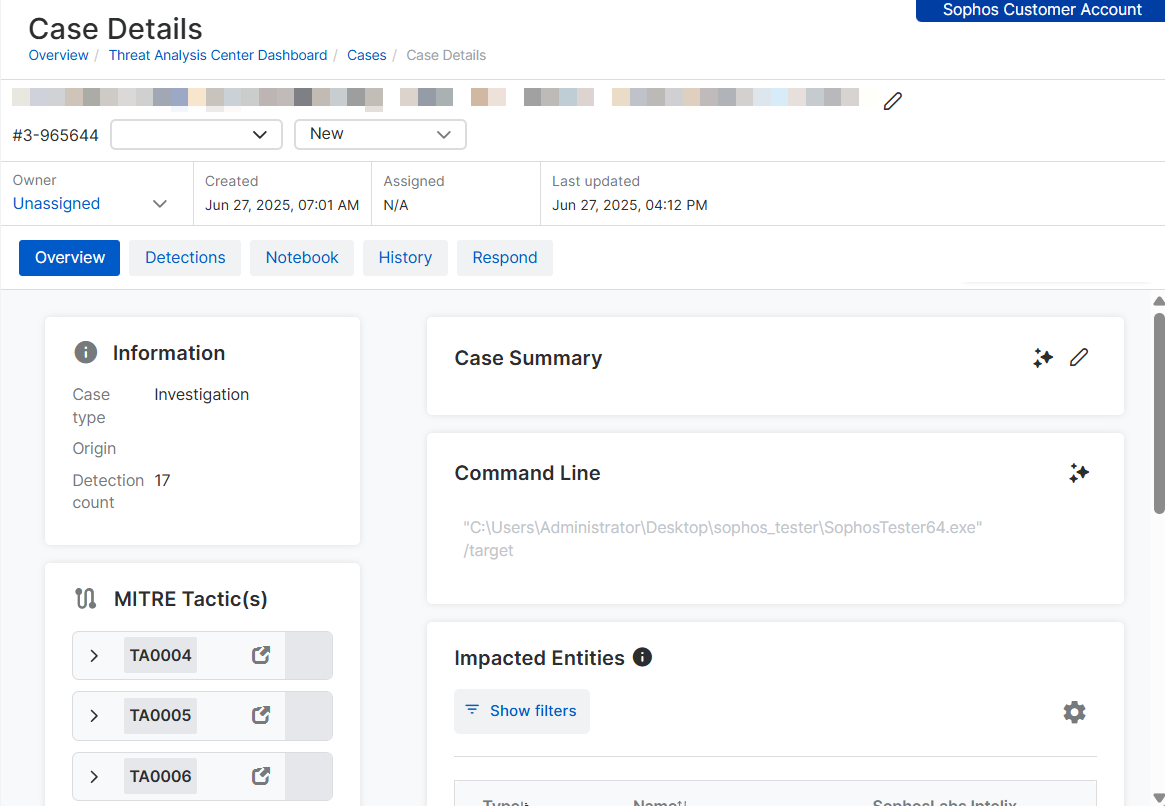
The system generates AI-powered case summaries that provide context on detected threats, reducing the manual investigation burden. Security analysts can quickly understand:
- What threat was detected and why
- Which endpoints are affected
- The timeline of suspicious activity
- Recommended response actions
MITRE ATT&CK Framework Mapping
Each detection is mapped to the MITRE ATT&CK Framework: a globally recognized taxonomy of real-world attacker techniques. This helps organizations understand not just what was detected, but how adversaries are attacking them, enabling strategic defensive improvements
Device Exposure Analysis
Sophos EDR provides visibility into how exposed each endpoint is to compromise, considering factors like unpatched vulnerabilities, weak security configurations, and user behavior patterns. This continuous risk scoring helps prioritize remediation efforts.
Rich Search Capabilities
Security analysts can query endpoint data using AI-powered search (no SQL skills required) or pre-built threat hunting templates. Organizations can search for:
- Specific files or file hashes across all endpoints
- Suspicious network connections or DNS queries
- Process execution chains
- Admin tool usage (PowerShell, WMI, etc)
- User login anomalies
Forensic Investigation
Incident Timeline Reconstruction
Sophos EDR captures detailed forensic data that allows analysts to reconstruct the complete attack timeline: when the initial compromise occurred, what processes executed, which files were modified, and what lateral movement occured. This forensic capability is critical for understanding breach scope and root cause analysis
Guided Investigation Workflows
For organizations without experienced SOC analysts, Sophos provides guided workflows that walk analysts through the investigation process step-by-step, reducing the skill barrier and ensuring consistent incident handling
Cross-Endpoint Correlation
If one endpoint is compromised, Sophos can automatically search for similar indicators of compromise (IOCs) across the entire endpoint estate, identifying potentially related incidents or lateral movement attempts across multiple systems
Response Actions & Remediation
Graduated Response Options
Sophos EDR accomodates different response philosophies:
- Fully Automated: Configure policies to automatically execute containment actions when specific threat conditions are met
- Analyst-Approved: Analysts review threats and authorize response actions
- Manual Response: Security team investigates and determines appropriate remediation
Ransomware Rollback
The CryptoGuard rollback feature is particularly valuable: when ransomware encryption is detected, encrypted files are automatically restored from temporary backups created before the attack, often recovering 100% of data. This capability alone can reduce ransomware response costs and downtime by orders of magnitude
Quarantine & Isolation
Analysts can immediately isolate specific endpoints from the network while maintaining remote access for investigation and remediation, preventing threat propagation while investigation continues
Management Console (Sophos Central)
Unified Dashboard
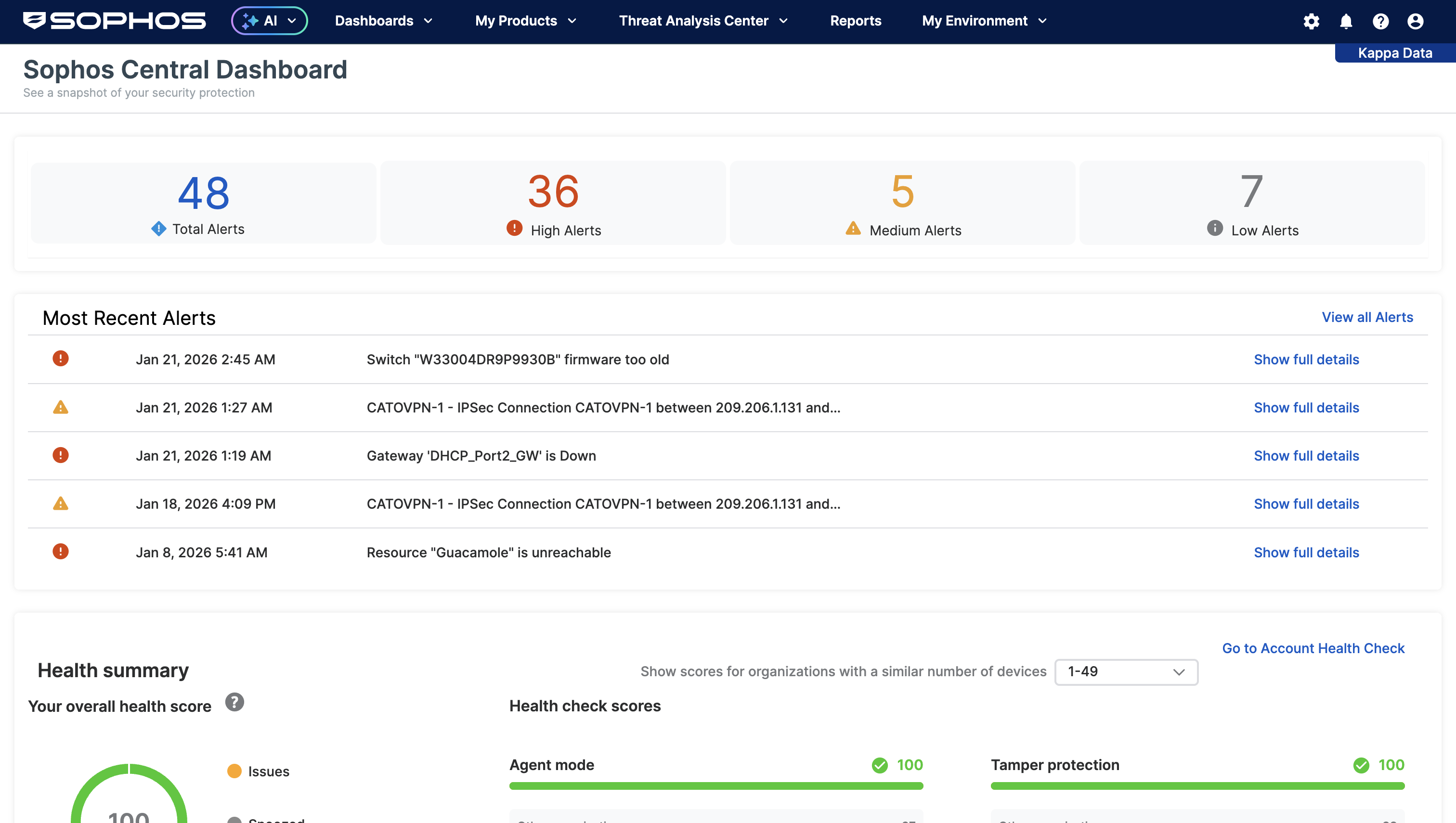
Sophos Central presents a single consolidated view of:
- Most recent alerts with priority indicators
- Endpoint health status across the organization
- Account health check (compliance with recommended security settings)
- Device inventory and patch status
- Security posture trending over time
Policy Management
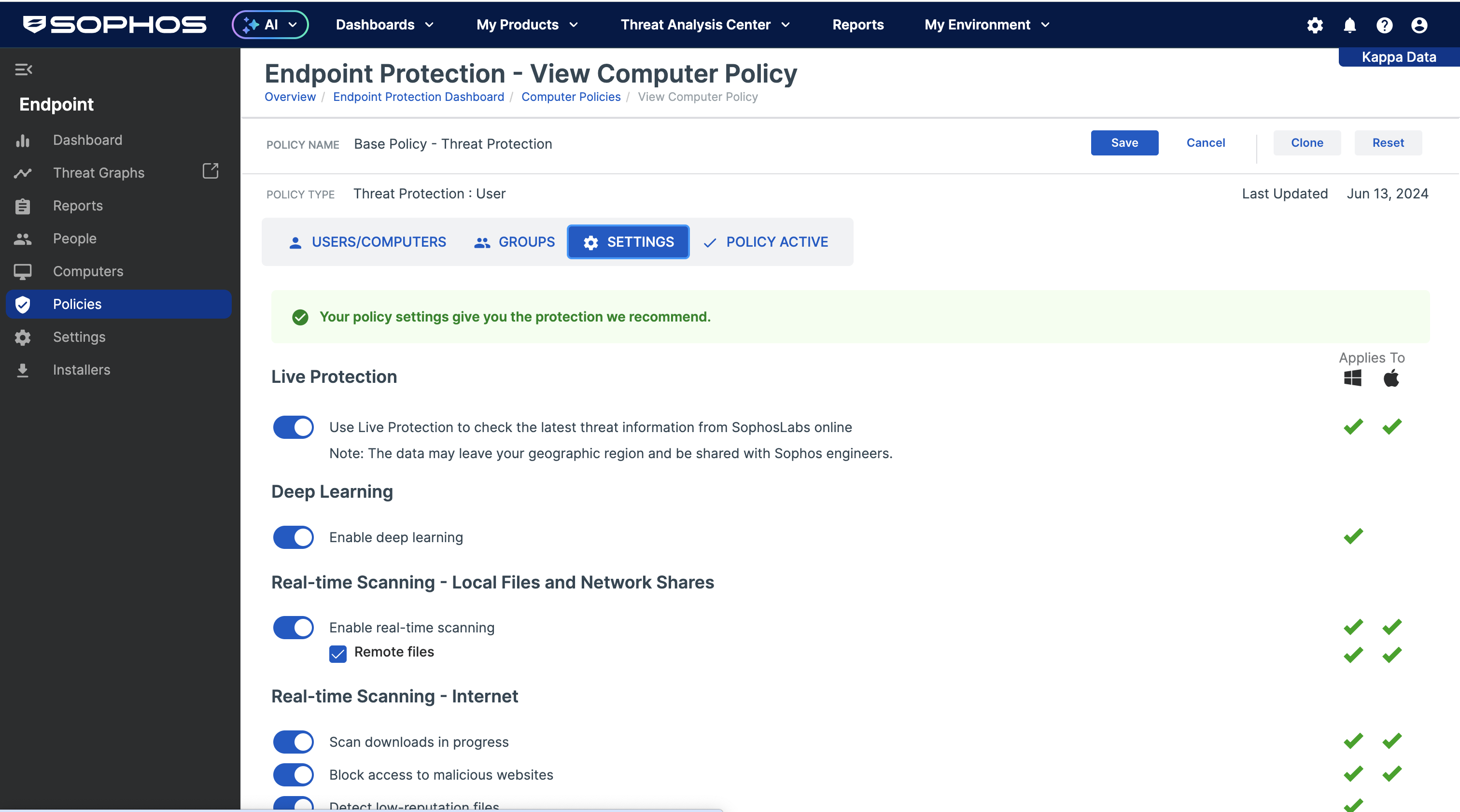
Administrators can create and deploy policies that follow users rather than specific devices.
Policies control:
- Threat detection sensitivity and response automation levels
- Acceptable applications and web access
- USB and removable media access
- Encryption requirements
- Administrator privilege usage
Policies can be role-based (applying different rules to executives vs contractors) or segment-based (different rules for finance systems vs general users)
Reporting & Compliance
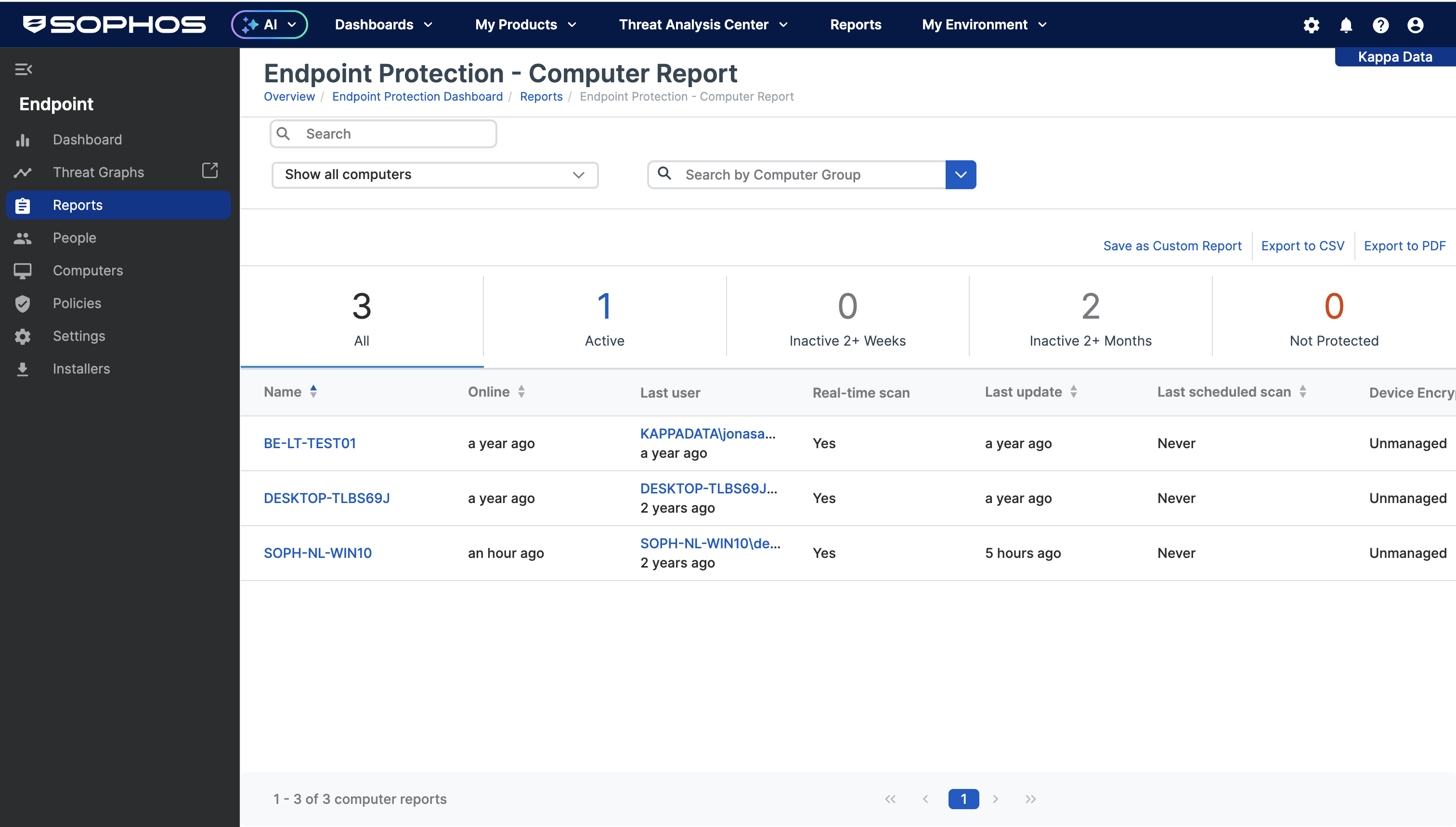
Sophos Central generates detailed reports for compliance audits, executive dashboards, and operational analytics
- Threat statistics and trends
- Incident response timelines
- Live Response session audits
- Policy effectiveness metrics
- Endpoint compliance status
Threat Intelligence & Analysis
SophosLabs Intelix Integration
Every file encountered by Sophos EDR is evaluated against SophosLabs' global threat intelligence database. Intelix uses:
- File reputation analysis: Compares files against millions of known good/bad samples
- Machine learning classification: Identifies malicious attributes even in previously unknown files
- URL categorization: Identifies phishing, malware hosting, and command-and-control domains
- IP reputation: Flags suspicious network destinations
Cloud Sandbox Analysis
For suspicious files, Sophos automatically submits them to the cloud-based Sophos Sandbox where they're safely executed in an isolated environment to observe their actual behavior. The sandbox includes Intercept X's detection technologies (deep learning, exploit detection, CryptoGuard), providing detailed analysis of how files behave under real-world conditions
Threat Intelligence Sharing
Threat intelligence is automatically shared across the Sophos Security Ecosystem. When an endpoint detects malware, that intelligence is immediately available to:
- Sophos firewalls (to block malicious traffic)
- Sophos email security (to block phishing emails from similar sources)
- Sophos mobile security (to protect mobile endpoints)
- Other Sophos customers' systems (through SophosLabs)
Conclusion
Sophos EDR represents a comprehensive, modern approach to endpoint threat detection and response. For resellers, the platform's positioning across enterprise, mid-market, and newly-launched SMB segments (Endpoint 100) creates diverse market opportunities. The architecture combines prevention-first capabilities (CryptoGuard, exploit prevention, deep learning) with advanced detection and forensic investigation tools, supported by industry-leading threat intelligence and a unified management platform. Cross-sell opportunities to MDR, XDR, and adjacent Sophos products enable customers to progressively build comprehensive security stacks while partners grow account value. The combination of enterprise-grade capabilities with simplified SMB deployment through Endpoint 100 positions Sophos as a leader across the entire organizational size spectrum