Barracuda EDR
Barracuda EDR - Overview

Barracuda's endpoint detection and response (EDR) offering operates as a core component of the Barracuda Managed XDR (Extended Detection and Response) platform: a unified security operations platform built for managed service providers (MSPs) and enterprises seeking SOC-as-a-Service (SOCaaS) capabilities. Unlike traditional standalone EDR solutions that focus solely on endpoint protection, Barracuda Managed XDR integrates EDR with SIEM (Security Information and Event Management), SOAR (Security Orchestration, Automation and Response), and a mature 24/7 Security Operations Center (SOC), creating a layered defense architecture managed by security experts around the clock.
The platform differentiates itself through its partnership with SentinelOne, a leader in autonomous endpoint security. Rather than building EDR capabilities from scratch, Barracuda strategically selected SentinelOne's Singularity XDR platform and the acquired SKOUT platform for its superior API capabilities, flexible workflow integrations, and proven threat detection efficacy. This partnership enables two distinct deployment models: a fully managed offering powered by SentinelOne with Barracuda SOC oversight, and a monitored option allowing customers to integrate their existing EDR solutions. The critical distinction, and one that addresses a significant market need, is that Barracuda augments any EDR with its SOC expertise, threat intelligence, and automated response capabilities, meaning organizations already invested in Microsoft Defender, CrowdStrike, or other EDR platforms can now leverage Barracuda's managed services layer.
At its foundation, Barracuda Managed XDR operates on Barracuda's cloud infrastructure delivered on a SaaS model, processing nearly 11 trillion events in 2024 from over 40 integrated data sources and flagging over 1 million risks. The platform combines proprietary detection rules mapped to the MITRE ATT&CK framework with an industry-leading threat intelligence database containing over 11 billion Indicators of Compromise (IOCs), ensuring threats are detected faster and organizations can predict attackers' next moves with higher accuracy.
Positioning
Primary Target Market Segments
Barracuda Managed XDR EDR is strategically positioned for two primary audiences
Resource-Constrained Organizations (Mid Market & Enterprise)
Organizations lacking dedicated security operations teams or facing acute talent shortages benefit most from Barracuda's managed SOC model. Rather than recruiting expensive security analysts, organizations instantly augment their internal teams with tenured security experts providing around-the-clock threat monitoring and response. This positioning directly addresses the industry's chronic cybersecurity workforce shortage, accelerating detection and response times from weeks or months to minutes
Managed Service Providers (MSPs)
Barracuda has architected Managed XDR as the first XDR platform purpose-built for MSPs. The multi-tenant architecture and centralized dashboard enable MSPs to offer comprehensive security services aligned to today's business environments. MSPs can bundle Barracuda Managed XDR with other Barracuda solutions or third-party tools, creating a unified security-as-a-service offering to their SMB and mid-market customer base.
Cross-Sell Opportunities
Barracuda's integrated product portfolio creates natural cross-sell momentum:
-
Email Protection Integration (High-Priority) Barracuda is currently running a limited-time promotion offering free Barracuda Managed XDR Cloud Security when customer purchase Barracuda Email Protection plans. Email remains the #1 attack vector, making this bundling strategy highly effective. When email threats establish a beachhead through phishing or credential theft, Managed XDR's endpoint and identity detection layers automatically activate, creating multi-layered defense.
-
CloudGen Firewall Integration (Network Layer) Barracuda's network security offering integrates with Managed XDR to provide visibility into network-based indicators of compromise. When ransomware attempts lateral movement across network segments or establishes command-and-control communications, both the network and endpoint layers detect and respons. This integration reduces product silos and alert fatigue by correlating network and endpoint telemetry
-
Data Protection & Backup Services Organizations adopting Managed XDR for ransomware defense naturally require backup and recovery capabilities. Barracuda's cloud-to-cloud and hybrid backup solutions complement EDR, ensuring rapid recovery if ransomware succeeds despite prevention measures.
-
Managed Vulnerability Service This newly introduced offering targets compliance-driven organizations. Barracuda handles vulnerability scanning, expert validation, and compliance reporting across DORA, NIS2,... MSPs can layer this vulnerability management with Managed XDR EDR to create comprehensive risk assessment and remediation services
Core Features: Foundational Capabilities
Barracuda EDR's core feature set operates across three functional pillars:
Endpoint Protection (Prevention Layer)
The prevention layer is powered by SentinelOne's autonomous protection architecture, which functions with or without cloud connectivity:
- Static AI Engine: Examines files before execution to identify malicious patterns and classify benign files, preventing known and emerging malware variants
- Behavioral AI Engine: Monitors kernel-level processes in real time, detecting fileless attacks, memory exploits, and polymorphic ransomware that signature-based tools miss
- Autonomous Protective Response: Automatically remediates threats at machine speed without requiring cloud round-trip latency or SOC analyst intervention
- 1-Click Remediation & Rollback: Reverses unauthorized system changes (Windows environments) or quarantines malicious files without requiring endpoint re-imaging, critical for recovery speed.
Threat Detection (Detection Layer)
Barracuda's detection architecture uniquely combines behavioral analytics, AI-powered correlation, and SOC-validated rule sets
| Threat Category | Detection Method | Operational Impact |
|---|---|---|
| Ransomware Execution | Real-time behavioral analytics monitoring file encryption patterns, security feature disablement, unusual file creation | Catches ransomware before mass encryption occurs; enables rollback |
| Application Misuse | Kernel-level process analysis for privilege escalation, fileless attacks, unauthorized script execution | Detects legitimate tools (e.g., PsExec, WMI) weaponized by attackers |
| Remote Code Execution (RCE) | Continuous kernel-level monitoring for unauthorized code execution patterns | Stops C2 communication and data exfiltration before impact |
| Fileless Attacks | Memory-based detection monitoring malicious script execution, process threads, and unusual memory activity | Defeats techniques bypassing traditional disk-based scanning |
| Lateral Movement | Network activity correlation and process thread analysis | 44% of foiled ransomware detected during lateral movement phase |
| Credential Theft & Account Takeover | Authentication pattern analysis, unusual login geo-locations, MFA fatigue attacks | Critical for cloud environments and remote workforces |
| Crypto Mining | CPU/GPU utilization anomaly detection | Prevents resource theft and insider threats |
The detection rules are explicitly mapped to the MITRE ATT&CK framework, enabling security teams to understand which attacker techniques each detection addresses and identify coverage gaps
Threat Response & Recovery (Response Layer)
The response layer distinguishes Barracuda through automated threat response (ATR) capabilities, particularly the recent integration with Microsoft Defender for Endpoint
Automated Threat Response workflow for Microsoft Defender
- Detection Phase: Microsoft Defender for Endpoint identifies a high-risk threat (ransomware, credential misuse etc)
- Barracuda Integration: Threat triggers an alarm in Barracuda XDR, which combines Defender's detection data with Barracuda's SOAR and threat intelligence
- Risk Determination: Barracuda's AI-driven algorithms assess severity (high, medium, low)
- Automated Isolation: If high-severity threat confirmed, Barracuda automatically isolates the endpoint via Defender API, severing all inbound/outbound network connectivity
- SOC Notification: High-severity alert generated with immediate phone call follow-up from Barracuda's Security Operations Center
- Recovery: Once threat cleared by SOC analysts, connectivity automatically restored
This ATR workflow enables containment in seconds to minutes, versus the manual isolation processes that typically require 24-48 hours. For example, when a manufacturing company suffered Akira ransomware attack, automated response isolated impacted endpoints before ransomware could encrypt additional servers, enabling rapid recovery.
Additional Response Capabilities Across Platform
- Automatic endpoint isolation via API for SentinelOne, AWS, Azure and Microsoft 365 environmnets
- Malicious process termination
- File quarantine and removal
- Compromised cloud account disablement (within 30 seconds for MS365)
- Command-and-control (C2) connection blocking at firewall layer
Feature Overview
Management & Visibility
Unified Web-Based Dashboard
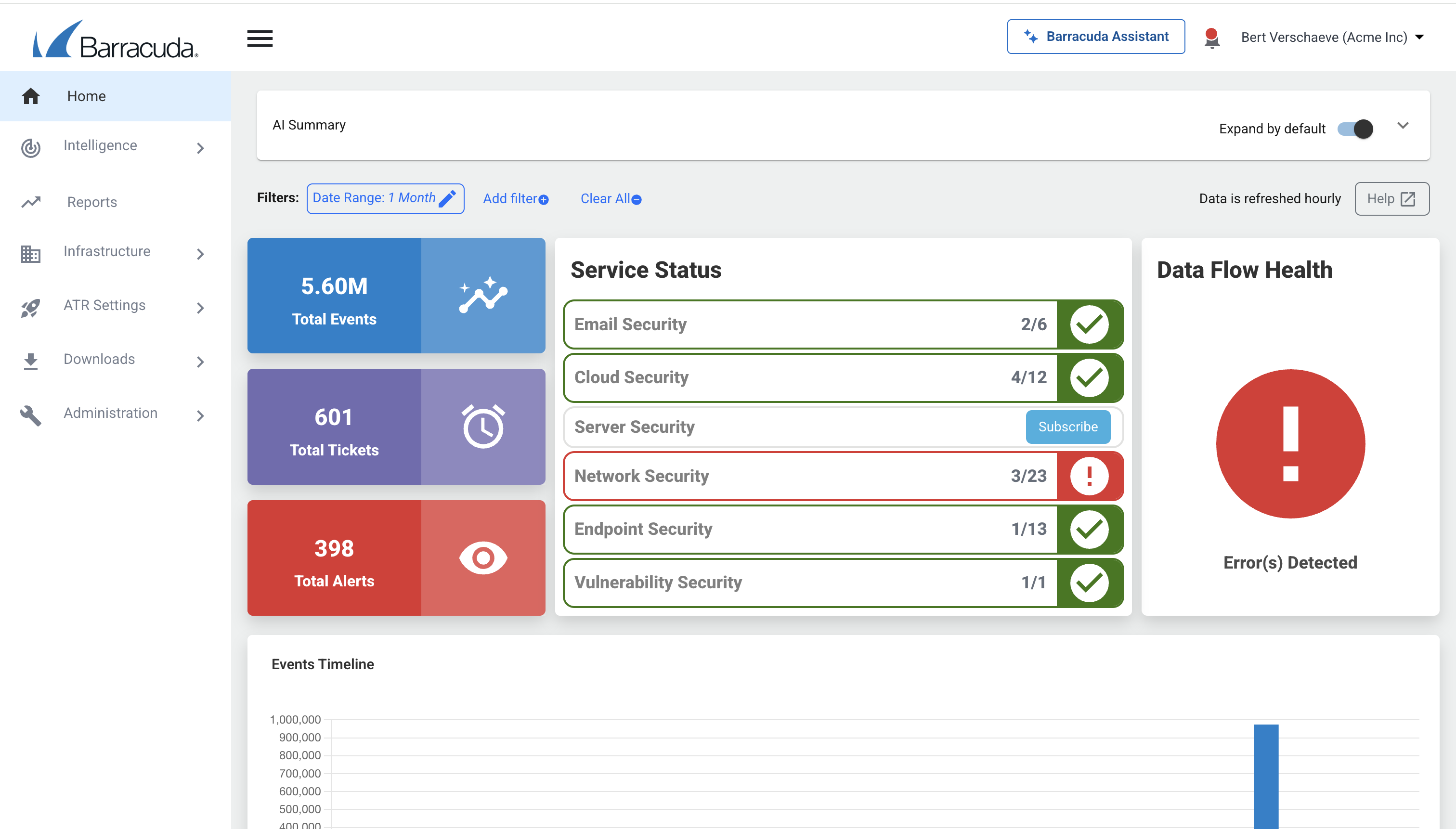
The Barracuda XDR Dashboard serves as the single configuration and reporting interface, providing network administrators with centralized visibility across all protected endpoints, detected threats, and SOC-managed incidents. The dashboard is accessible remotely and integrates data from 40+ sources including
- SentinelOne endpoint sensors
- Microsoft Defender for Endpoint
- CloudGen Firewall network events
- Email gateway logs
- Azure/Microsoft 365 audit trails
- Custom log integrations via API
Multi-Tenant Architecture for MSPs
Partners can manage hundreds of customer accounts through a single pane of glass, with role-based access controls isolating customer data. This architecture allows MSPs to white-label reporting and maintain separate alert queues per customer without operational complexity.
Threat Intelligence & Analytics
11 Billion Indicator Database
Barracuda maintains one of the industry's largest threat intelligence repositories, informed by:
- Barracuda's proprietary sensors across 200.000+ global customers
- Community-sourced intelligence from security research partners
- Public threat feeds and government advisories
- Dark web monitoring for stolen credentials and zero-day exploits
When Barracuda SOC encounters a new threat, the correlation engine automatically checks the incident against billions of known indicators, enabling near-instantaneous identification of whether the threat is known, emerging, or novel
AI-Powered Behavioral Analytics
Unlike signature-based detection limited to known malware patterns, Barracuda's behavioral AI engine performs real-time analysis of:
- Kernel-level process relationships and thread execution patterns
- File I/O activity and encryption patterns
- Network socket connections and data exfiltration attempts
- Registry modifications and scheduled task creation
- Service installation and privilege escalation sequences
This enables detection of zero-day exploits and novel attack techniques that have never been seen before, as the engine recognizes statistical deviations from normal baseline behavior rather than relying on signatures
Integration & Extensibility
Multi-EDR Support (Monitored Model)
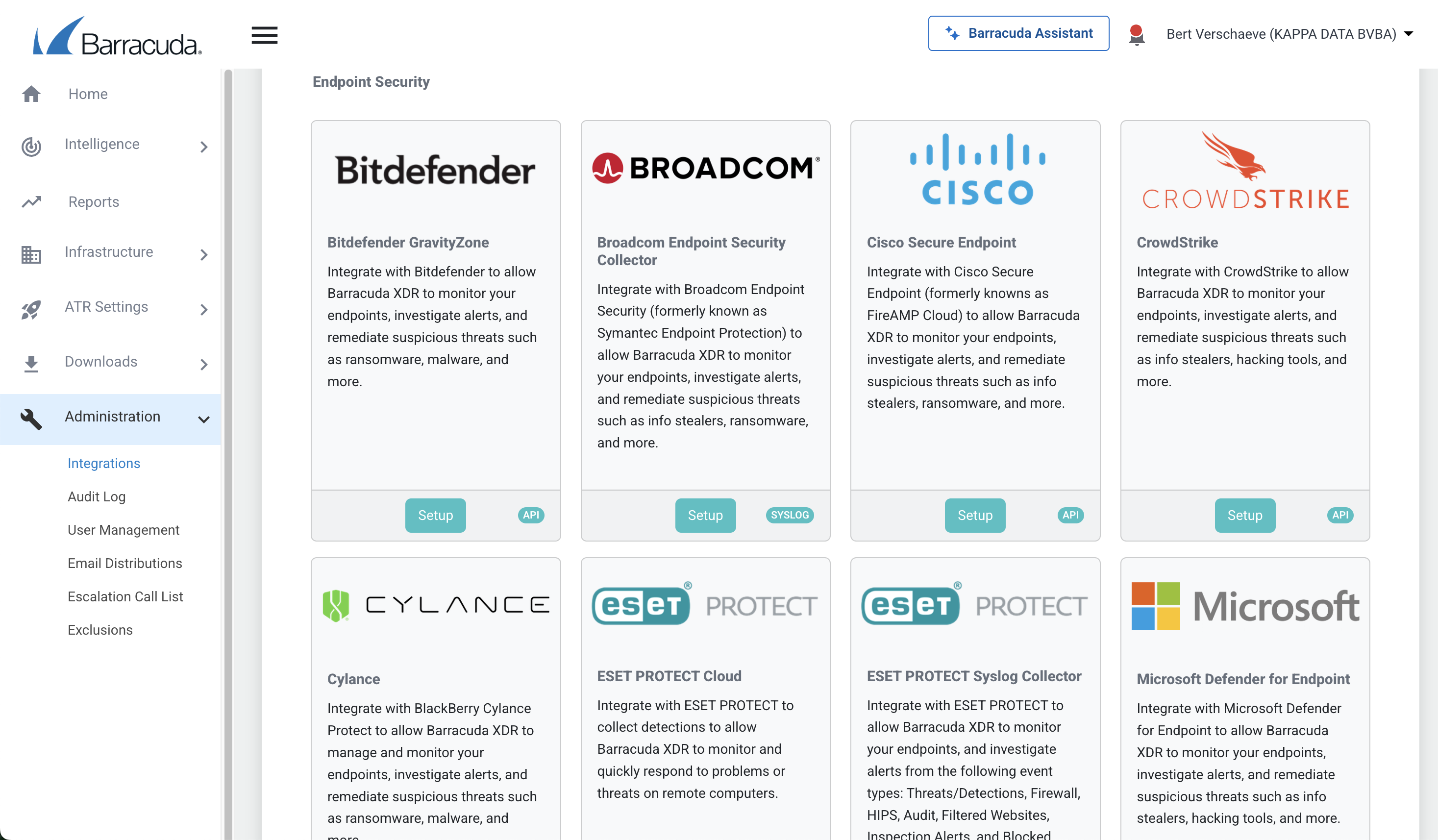
Organizations with existing EDR investments can layer Barracuda's SOC and SOAR capabilities on top of:
- Microsoft Defender for Endpoint (with new Automated Threat Response)
- SentinelOne (fully managed or customer-managed)
- CrowdStrike Falcon (with new Automated Threat Response!)
- Bitdefender GravityZone
- Broadcom Endpoint Security
- Cisco Secure Endpoint
- Cylance
- ESET PROTECT
- Sophos Central
- Tanium
- Trend Micro
API-Driven Architecture
Barracuda's public APIs enable
- Integration with existing SIEM platforms (Splunk, ELK, Datadog,...)
- Custom workflow automation via SOAR platforms
- Third-party ticketing system integration (Jira, ServiceNow)
- Custom detection rules and response playbooks
- Data export for forensic analysis and threat hunting
Security Operations Center (SOC) services
Barracuda operates a distributed SOC infrastructure across North America, Europe, Middle East, Africa and Asia-Pacific regions. Multi-tiered teams ensure:
- Tier 1: Automated alert triage, noise reduction, and policy enforcement
- Tier 2: SOC analyst investigation, threat hunting and correlation
- Tier 3: Incident commander coordination for complex, multi-stage attacks
Proactive Threat Hunting
Rather than purely reactive detection, Barracuda's SOC conducts:
- Query-based searches across telemetry for known attacker TTPs (Tactics, Techniques, Procedures)
- Scheduled hunts targeting industry-specific or customer-specific risk profiles
- Behavioral anomaly investigations identifying persistence mechanisms, lateral movement patterns, and data exfiltration
- Supply chain threat intelligence sharing across customer base
Direct Escalation Pathways
When high-risk incidents occur, customers receive direct phone contact from the Barracuda SOC, not automated ticketing systems. This human-led triage enables faster context-gathering and remediation decision-making, particularly critical during ransomware incidents where hours determine recovery scope
Microsoft Defender for Endpoint Integration (Strategic Differentiation)
The integration with Microsoft Defender for Endpoint represents Barracuda's most significant recent development and is worth detailed examination, as it uniquely addresses organizations' existing Microsoft ecosystem investments:
Why this integration matters
Approximately 70% of enterprise environments use Microsoft Defender for Endpoint, often as part of Microsoft 365 or Windows licensing bundles. However, Defender alone lacks:
- 24/7 managed SOC oversight
- Automated threat response capabilities
- Correlation with non-Microsoft telemetry (firewalls, email, cloud services)
- Industry-specific threat hunting
- Compliance-focused investigation and reporting
Barracuda's integration adds managed services on top of an organization's existing Defender investment, addressing these gaps without replacement costs
Automated Threat Response (ATR) for Defender
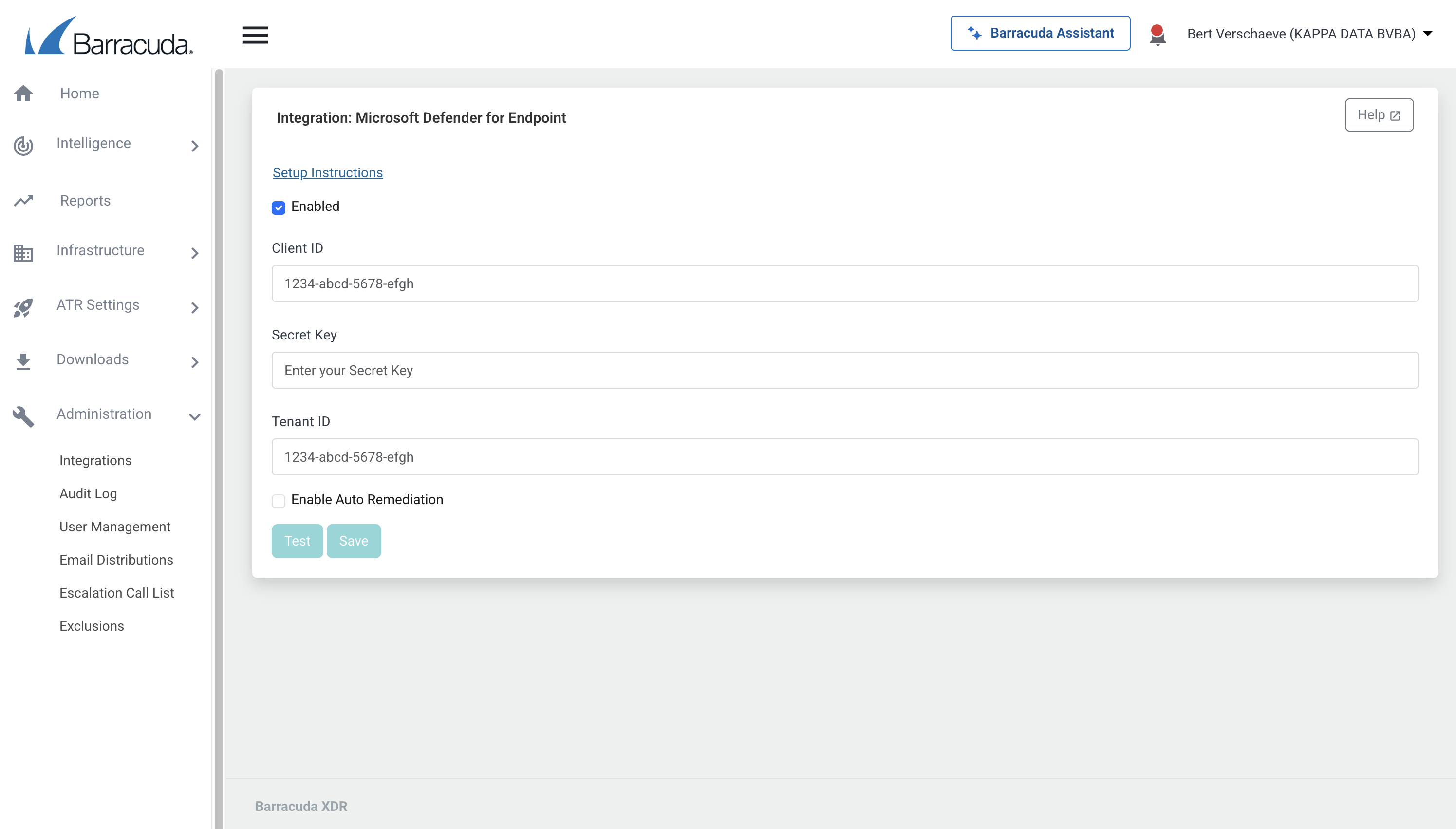
When high-risk threats are detected (ransomware, credential misuse, lateral movement), Barracuda can automatically:
- Isolate the Endpoint: Severing all network connectivity while preserving the endpoint for forensics
- Alert & Escalet: Send high-severity alert to customer IT team with SOC analyst contact
- Restore Connectivity: Automatically re-enable network access once the SOC validates threat remediation
Even when resellers are positioning Microsoft Defender as part of their Microsoft bundles Barracuda XDR can respond when alerts from Defender are triggered. This is a major upsell opportunity for Microsoft partners
Hybrid Threat Detection
Barracuda's platform correlates Defender's detection data with:
- Email gateway threats (phishing campaigns preceding account compromise)
- Network-layer C2 detection (blocking attacker command channels)
- Cloud identity anomalies (impossible travel, unusual permissions changes)
- Server security events (lateral movement indicators)
This creates a unified attack narrative that Defender alone cannot construct, enabling faster root-cause analysis and more precise containment
SentinelOne Behavior AI & Autonomous Response
For organizations adopting the fully managed SentinelOne offering through Barracuda, the endpoint protection layer includes capabilities that represent the state-of-the-art in autonomous EDR:
Kernel-Level Process Monitoring
SentinelOne's behavioral engine monitors every process thread at the kernel level, tracking:
- Parent-child process relationships (detecting process injection and code caves)
- Memory access patterns (identifying shellcode and exploit development)
- File system operations (tracking ransomware encryption and exfiltration preparation)
- Network socket creation and data transmission
This real-time monitoring enables detection of sophisticated exploits while they are executing, versus post-mortem forensics
Autonomous Protective Response
The agent makes autonomous decisions to:
- Kill malicious process threads
- Quarantine files
- Block network connections
- Unload malicious DLLs
Critically, these decisions occur at the endpoint without cloud connectivity, enabling protection when WAN links fail.
Ransomware Rollback
If ransomware is detected after initial encryption, SentinelOne's rollback capability can:
- Restore encrypted files from pre-attack state
- Reverse unauthorized registry modifications
- Remove scheduled tasks and service installations
- Resume operations without complete data restore cycles
This capability is particularly valuable for healthcare and financial sectors where operational continuity directly impacts customer trust and regulatory compliance.
Conclusion
Barracuda Managed XDR EDR represents a strategically differentiated approach to endpoint security, combining autonomous SentinelOne protection with Barracuda's mature SOC services, SOAR automation, and threat intelligence capabilities. The platform particularly excels for organizations seeking to:
- Augment understaffed security teams with 24/7 SOC coverage without hiring costs
- Extend existing endpoint investments (particularly Microsoft Defender) with managed services
- Address industry-specific compliance requirements (healthcare, financial, critical infrastructure)
- Achieve rapid automated response to ransomware and credential-based attacks
- Bundle security services (endpoint, email, network, cloud) through a single managed provider
The strategic integration with Microsoft Defender, combined with the flexibility to support monitored deployments, positions Barracuda as a pragmatic solution for enterprises balancing existing technology investments with modernized security operations. For MSPs and managed security providers, the multi-tenant architecture and partner-first positioning create compelling margin and differentiation opportunities in the increasingly crowded XDR market.