Allied Telesis AMF & Vista Manager
Overview

Allied Telesis Autonomous Management Framework (AMF) is an embedded automation and management framework that turns an Allied Telesis network into a single, centrallly managed system, with zero-touch backup, provisioning, upgrade, and recovery for switches, firewalls and wireless devices. Vista Manager EX is the "single pane of glass" GUI and monitoring platform that visualizes this AMF network (plus AWC wireless and SD-WAN), providing topology maps, dashboards, and plug-ins such as SNMP to extend monitoring to non-Allied devices. Together, they are positioned to simplify operations, cut operating costs, and make mid-size and distributed networks manageable by small IT teams
What is AMF?
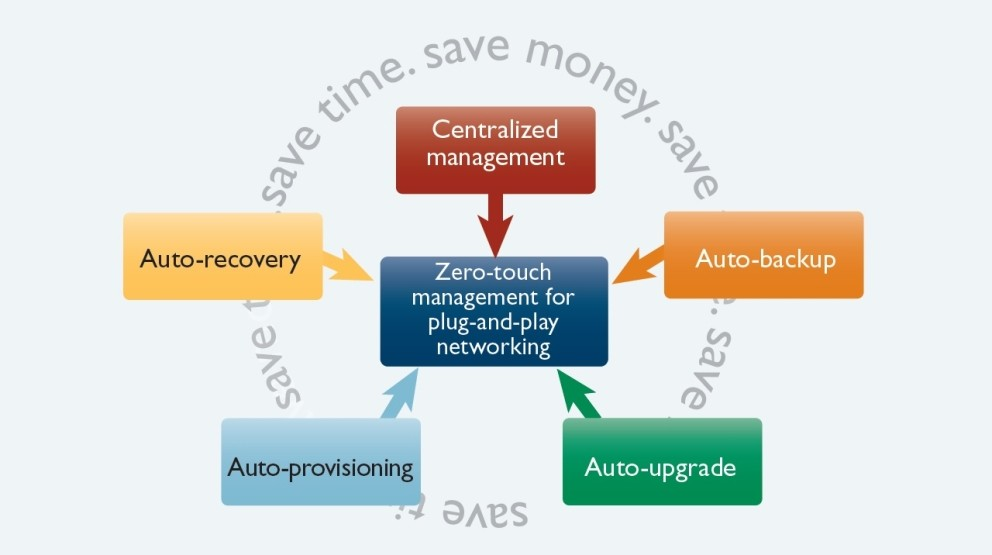
Autonomous Management Framework (AMF) is a network automation and management layer built into Allied Telesis switches, firewalls, and certain wireless products, allowing the entire network to be treated as one converged entity instead of many individual devices. It provides centralized management for configuration, firmware, and monitoring; zero-touch or one-touch backup, provisioning, upgrade, and recovery; and smart commands that operate on one, many, or all devices at once.
From a business perspective, AMF aims to reduce the time and skill required to maintain the network by automating routine tasks like backups, firmware rollouts, adding new devices, and replacing failed units, which can reduce network operating costs by up to 60% according to Allied Telesis collateral. AMF is available into hardware, via AMF controller for very large networks, or in a cloud-based form (AMF Cloud) that runs as a virtual appliance and supports multi-tenant use.
What is Vista Manager EX?
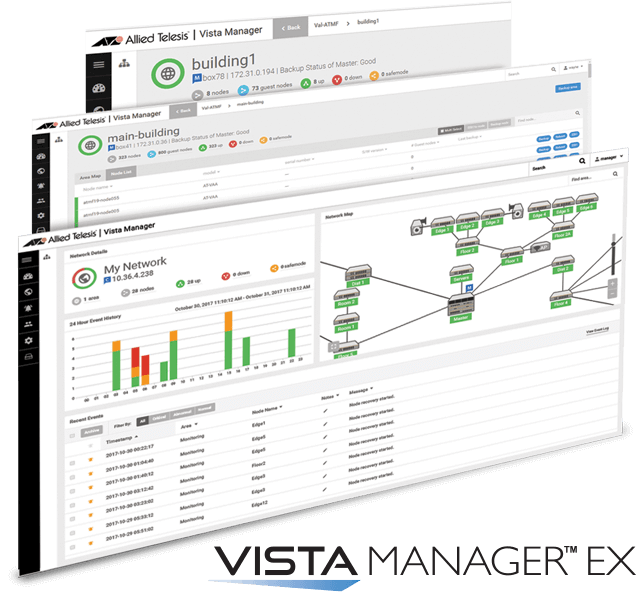
Vista Manager EX is Allied Telesis' unified network monitoring and management application that provides a graphical, single-pane-of-glass interface across AMF wired networks, AWC wireless, and SD-WAN. It automatically builds a topology map of switches, firewalls, and wireless access points, and offers dashboards that show device status, event alarms, and bandwidth utilization in real-time
Vista Manager EX can be deployed as a virtual appliance or as software for Windows Server, with plug-ins such as AWC for wireless management and SNMP plug-in that discovers and manages a wide range of third-party devices. It supports management of up to around 2000 devices, multi-network/tenant separation, and integrated SD-WAN orchestration that visualizes VPN links and automatically optimizes application traffic between branches
Relationship between AMF and Vista Manager
AMF provides the underlying automation and centralized control for Allied Telesis networks, while Vista Manager EX is the visual front end that exposes and orchestrates those capabilities. Vista Manager consumes information from AMF (and from AWC, SD-WAN, and SNMP) to build maps and dashboards, and it can push configuration and feature licenses back into AMF nodes, effectively becoming the cockpit for day-to-day operations.
Conceptually, AMF is the "autopilot and engine management system" inside the aircraft (the network), whereas Vista Manager EX is the flight deck where the pilots sit, see the instruments, and choose what the autopilot should do. This separation allows AMF to operate even in headless or cloud-managed scenarios, while giving administrators a powerful yet approachable GUI when Vista Manager EX is in place.
How to position
Target customer profiles
AMF and Vista Manager are designed for organizations that need enterprise-grade networking, but have limited operational resources, such as mid-size enterprises, education, healthcare, hospitality, retail, manufacturing, and local government. Multi-site businesses and distributed enterprises benefit strongly from AMF's ability to manage devices across campuses, cities, or continents from a central point, including remote branches connected over WAN links.
They are also relevant for environments where downtime is costly but dedicated networking staff are scarce: for example, hospitals, factories, logistics sites, and public sector campuses where IT teams are small and often over-stretched. In such contexts the promise of "zero-touch" deployment, automated recovery, and topology-level visibility speaks directly to risk reduction and operational continuity.
Easy entry-points
The most straightforward wins are customers already using Allied Telesis switching, firewalls, or wireless, but still managing them device-by-device or with basic CLI/SNMP tools. In these environments, adding AMF (if not already licensed) and Vista Manager EX can be positioned as a way to "unlock" automation capabilities already present in the infrastructure and consolidate operations into one console.
Another low-hanging segment is customers running unmanaged or lightly managed campus/branch networks who struggle with manual firmware upgrades, complex VLAN changes, and error-prone device replacements. Here, AMF's auto-backup, auto-upgrade, auto-provisioning, and auto-recovery directly address pain points around time, risk of misconfiguration, and need for on-site experts.
A third opportunity lies with organizations that demand visual oversight and reporting: for compliance, audits, or board-level reporting, but only have fragmented monitoring today. Vista Manager's real-time maps, health dashboards, event views, and VLAN visualization translate complex technical states into visual narratives that non-specialists can understand.
Cross-sell and up-sell plays
AMF and Vista Manager are natural cross-sells with Allied Telesis switches, firewalls (including UTM/VPN devices used for SD-WAN), and wireless access points, because they provide the management and automation layer that ties those products together. As customers upgrade or expand their Allied estate, positioning AMF/Vista Manager as the "operating system" for the entire network turns individual hardware deals into a long-term platform conversation.
There is also a cross-sell story into security cameras, IP phones, and other third-party devices that can act as AMF "guests" or be discovered via SNMP, providing broader visibility and some automation for connected endpoints. For MSPs or large distributed enterprises, AMF Cloud plus Vista Manager EX enables managed network services and multi-tenant operations, which can be framed as a foundation for NaaS or managed SD-WAN offerings.
Competitive differentiation angles
Against traditional, manually operated networks, AMF and Vista Manager can be framed as bringing data-center style automation and "software-defined" concepts to campus and branch environments without the complexity of full-blown SDN controllers. In comparison with some cloud-only management solutions, AMF's ability to run integrated on-premises, on controllers, or as cloud appliances gives flexibility for customers with strict data-sovereignty or offline-operation requirements.
Feature-wise the combination of zero-touch replacement, rolling firmware upgrades, and topology-aware management is a compelling story for customers burned by past outages during maintenance windows. Vista Manager's integrated SD-WAN map and AWC wireless optimization (Channel Blanket, Smart Connect) also create a converged narrative across LAN, WLAN, and WAN, which many legacy NMS products lack.
Core Features
Centralized, topology-aware management
AMF allows many or all devices across a network (locally or worldwide) to be centrally managed as a single system, with commands and changes applied to one, many, or all nodes. Vista Manager EX builds on this by automatically generating an integrated topology map of switches, firewalls, and wireless APs, grouping them by branch or building for intuitive visual control.
In practical terms, this means administrators no longer need to long into dozens of separate devices to understand the network; they can see how everything is connected and interact with it from one place, significantly shortening troubleshooting and change windows.
Automation and zero-touch operations
AMF provides a suite of automation capabilities: auto backup, auto-upgrade, auto-provisioning, and auto-recovery. This together enables zero-touch or one-touch management. Auto-backup saves configuration and firmware for the entire network to a central library daily, auto-upgrade orchestrates firmware rollout (with rolling reboots to preserve connectivity), auto-provisioning enables plug-and-play addition of new devices, and auto-recovery performs zero-touch replacement of failed nodes.
These features directly reduce the need for skilled engineers to be on-site at remote locations, as local staff can simply plug in new hardware and let AMF do the rest, while Vista Manager provides the visual feedback that everything completed successfully.
Multi-site and cloud-ready scalability
AMF can manage networks that span campuses, cities, or continents, including remote offices connected via encrypted tunnels, and it scales up to thousands of devices when an AMF Controller is used. Devices in remote locations can be managed as easily as those on the main site, and AMF Cloud further extends this by moving controllers into virtual appliances accessible over private or public cloud infrastructure, including a multi-tenant variant for service providers.
Vista Manager EX supports management of up to around 2000 devices and multiple networks/tenants, automatically discovering SNMP agents and presenting an overall topology tree even in large environments. This scalability allows the same toolset to be used from small single-site deployments up to large distributed enterprises.
Integrated SD-WAN and wireless management
Vista Manager EX includes an SD-WAN orchestrator that uses Allied Telesis UTM firewalls and VPN routers as branch gateways, optimizing traffic over multiple WAN links for better performance and cost efficiency. Administrators can define acceptable performance metrics per application, and the system monitors VPN link quality to dynamically move time-sensitive or critical traffic to the optimal path, visualized on a color-coded WAN map.
For wireless, Vista Manager EX with the AWS plug-in provides unified management and optimization of Allied Telesis wireless APs, including automatic channel and power optimization, Channel Blanket for seamless roaming, and AWC Smart Connect for simplified deployment and resilient wireless uplinks. This builds a coherent story of "one tool for wired, wireless, and WAN" operations.
Openness to third-party devices
While AMF strongest automation applies to Allied Telesis products, it can also treat other devices such as IP phones and security cameras as AMF guests, improving visibility of what is connected to the network. Vista Manager's SNMP plug-in expands this further by auto-discovering and monitoring a wide variety of non-AMF devices using standard SNMP, with different view options and automated notifications and alerts for proactive management.
This openness allows AMF and Vista Manager to sit in brownfield environments where non-Allied gear exists at the edge, while still delivering central monitoring and some degree of control, which is critical for gradual migration strategies
Detailed feature overview
AMF
| Feature area | Key AMF capabilities | Business value |
|---|---|---|
| Centralized management | Single point of management for many or all devices across the network, with smart commands that operate on one, many, or all nodes. | Reduced complexity and time spent on routine operations, fewer configuration errors across devices. |
| Auto‑backup | Automatic daily backup of configuration and firmware files for all AMF devices into a central library, with options to store locally, on a server, or in the cloud. | Peace of mind, easy rollback after changes, compliance with backup and audit requirements. |
| Auto‑upgrade | Coordinated firmware upgrades with rolling reboot capability, ensuring that only one device in a group reboots at a time to maintain connectivity. | Safer maintenance windows, less downtime during upgrades, predictable change management. |
| Auto‑provisioning | Ability to pre‑provision devices before they are physically present; when plugged in, firmware and configuration are automatically pushed from the AMF Master, and unprovisioned devices are isolated until configured. | Plug‑and‑play network expansion, no need for experts on‑site, reduced risk from incorrect initial configuration. |
| Auto‑recovery | Zero‑touch replacement of failed devices: a replacement unit can be installed with no configuration, and AMF automatically restores its firmware and configuration. | Faster recovery from hardware failures, minimal business interruption, lower on‑site support costs. |
| AMF Controller | Extension of AMF to thousands of devices for large networks, acting as a centralized controller above individual Masters. | Enterprise‑scale automation and consistency across large or global deployments. |
| AMF Cloud | Virtualized AMF Master/Controller running in private or public cloud, including a multi‑tenant option for service providers and large distributed enterprises. | Cloud‑based access, easier disaster recovery, foundation for managed network services. |
| Security (AMF secure mode) | Encryption, authorization, and monitoring for AMF management traffic, increasing security of the management plane. | Protection of management operations and configurations from interception or tampering. |
Vista Manager EX
| Feature area | Key Vista Manager EX capabilities | Business value |
|---|---|---|
| Single‑pane dashboard | Central dashboard shows network details and status, events, alarms, and a topology map of wired, wireless, and WAN devices. | One place to see overall network health; easier for non‑specialists to understand issues and trends. |
| Integrated topology map | Auto‑created map of switches, firewalls, and wireless APs, with ability to group devices into branches or buildings and access each node’s GUI. | Intuitive understanding of how the network is physically and logically laid out, faster fault isolation. |
| Traffic and health visualization | Color‑coded views for utilization and bandwidth, link status, and critical events, including 24‑hour event graphs for health snapshots. | Quick identification of hotspots, bottlenecks, or recurring fault patterns without needing deep CLI expertise. |
| VLAN view | Ability to create and manage VLANs across multiple switches at once with a few clicks; color‑coded VLAN map showing data paths for key applications. | Greatly simplifies segmentation changes, reduces risk of misconfiguration when rolling out new services. |
| SD‑WAN orchestrator | WAN map showing VPN connections between branches, with status and performance; centralized definition of application performance metrics and automatic path selection using Allied Telesis firewalls/VPN routers. | Better application performance, more efficient use of WAN links, reduced need for manual VPN tuning. |
| AWC wireless management | Unified management of Allied Telesis APs with automatic channel/power optimization, Channel Blanket for seamless roaming, and AWC Smart Connect for resilient wireless uplinks. | Higher Wi‑Fi performance and reliability with less manual RF tuning, improved user experience. |
| SNMP plug‑in | Auto‑discovers and manages a wide range of SNMP‑speaking devices from multiple vendors; displays them in tree form and supports alerts and notifications. | Extends visibility and basic management to non‑Allied devices, enabling mixed‑vendor environments. |
| Multi‑network / multi‑tenant | Support for multiple logical networks or tenants, keeping management and visibility separated as needed. | Fits MSPs or organizations with segregated environments (e.g., production vs. guest vs. OT networks). |
| Scale | Management of up to around 2,000 devices, with automatic search for SNMP agents and easy topology viewing. | Suitable for both mid‑size and larger enterprises without changing tools. |